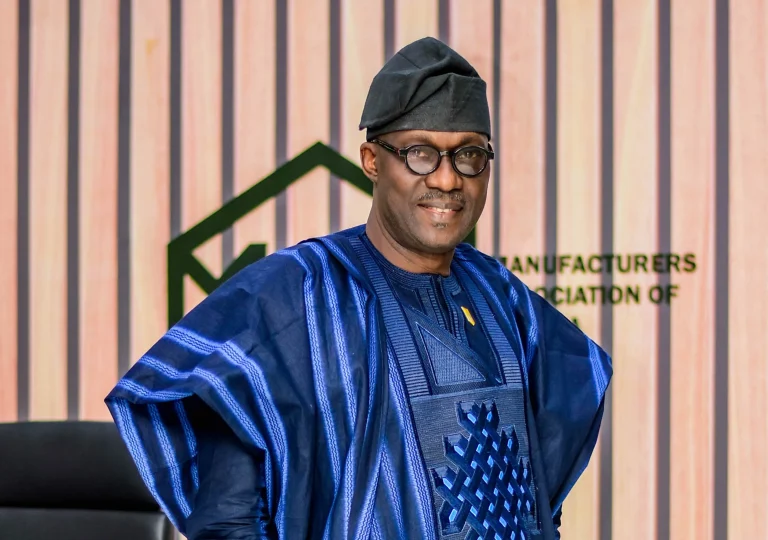
The Manufacturers Association of Nigeria has urged the Lagos State Government to become the first state to publish a harmonised tax code aligned with the new tax laws.
The association said the move would significantly reduce compliance costs and ease the burden of multiple taxation on manufacturers.
Speaking on Thursday at the 55th Annual General Meeting of MAN’s Apapa Branch in Lagos, the association’s President, Francis Meshioye, called for stronger safeguards against multiple taxes and levies under the new tax regime.
Meshioye urged the Lagos State Government to provide manufacturers with a single system for tax assessment and payment.
He said the system would eliminate duplication and uncertainty caused by demands from different government agencies and levels of administration.
According to him, the new tax laws provide an opportunity to reform Nigeria’s tax system through harmonisation, digitisation and simplified compliance.
However, he said deliberate safeguards were needed to ensure manufacturers benefited from the reforms.
Meshioye urged Lagos State to publish a harmonised tax code with one authority responsible for tax assessment and one portal for payments.
He said such a system would significantly reduce compliance costs for manufacturers.
The MAN president said manufacturers operating in major industrial and trade corridors, particularly Apapa, continued to face multiple taxes and levies from federal, state and local government authorities.
He said a truck transporting raw materials from the port to a factory could be stopped by several agencies before reaching its destination.
This, he said, comes in addition to corporate income tax, Value Added Tax and other state levies.
Meshioye also called for the establishment of a “No-Tout Zone” policy in Apapa, Amuwo and Kirikiri.
He said the policy would help protect legitimate revenue collection from illegal levies imposed by non-state actors along industrial and port corridors.
The MAN president further urged the Lagos State Government to work with the Nigerian Ports Authority and the Nigerian Shippers’ Council to create a single bill for port-related charges.
He said manufacturers should not be required to pay multiple charges to move a single container through the ports.
Meshioye said MAN was not seeking tax exemptions for manufacturers.
Instead, he said businesses wanted the taxes they paid to translate into improved infrastructure, security and other essential services.
He called for better roads, functional drainage systems and improved security in industrial clusters.
Meshioye also urged the Joint Revenue Board to ensure that states did not use the new tax regime as an opportunity to introduce additional taxes.
He said states should instead consolidate and simplify existing tax obligations.
In a separate interview, the MAN president said effective implementation of the new tax laws would expand Nigeria’s tax base while reducing the burden on compliant businesses.
He said sub-national governments needed to domesticate and fully implement the new tax framework for manufacturers to benefit from the intended relief.
Meshioye said the success of the reforms should be reflected in business expansion, increased investment and improved employment opportunities.
The Chairman of MAN’s Apapa Branch, Raphael Danilola, said multiple taxation, regulatory burdens, high interest rates, energy costs, insecurity and logistics challenges continued to affect manufacturers.
Danilola said the association was concerned about ensuring that tax reforms strengthened manufacturing competitiveness rather than creating additional pressure for businesses.
He urged the Lagos State Government to review the mandates of its agencies to eliminate duplication.
He also called for the harmonisation of national and state environmental laws to reduce compliance costs for manufacturers.
Meanwhile, the Executive Secretary of the Joint Revenue Board, Olusegun Adesokan, said the new tax administration framework had reduced more than 100 taxes to nine unified revenue heads at the sub-national level.
He said the revenue heads covered income tax, stamp duty, property tax, road tax, haulage levy, economic development levy, harmonised levy, user charges and daily tickets.
Adesokan added that the new framework abolished roadblocks mounted for revenue collection along transportation corridors.
He said the framework also prohibited cash tax payments.
The MAN Director-General, Segin Ajayi-Kadir, said the four tax laws that took effect on January 1, 2026, could reposition Nigeria’s tax system to support productivity if effectively implemented.
He said manufacturers previously paid between 120 and 160 taxes and levies.
According to him, the new tax framework is expected to limit the number of taxes and levies payable by manufacturers to no more than nine.
Ajayi-Kadir said 16 of Nigeria’s 36 states had already subscribed to the federal tax law by domesticating the framework and limiting the number of taxes and levies collected.
He said the reforms would make tax compliance easier and provide greater certainty for manufacturers throughout the financial year.
The MAN Director-General added that manufacturers wanted a tax regime that simplified compliance, encouraged productivity and provided an effective mechanism for resolving disputes with revenue authorities.