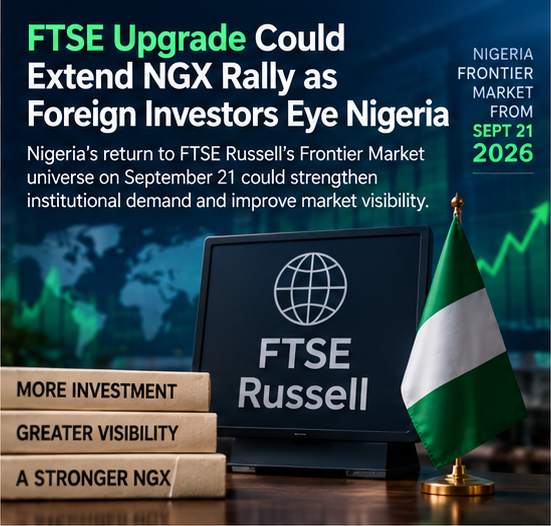
Nigeria’s return to the FTSE Russell Frontier Market Index could provide fresh momentum for the Nigerian equities market despite the recent wave of profit-taking, according to investment analysts.
Coronation Asset Management expects the market’s broader positive trajectory to remain supported by institutional positioning ahead of Nigeria’s formal re-entry into the international benchmark universe.
FTSE Russell is scheduled to restore Nigeria from “Unclassified” to Frontier Market status from the opening of trading on September 21, 2026.
The development represents a significant milestone for Nigeria’s capital market because inclusion in major international indices can influence how global investment funds allocate capital.
Nigeria Returns After Three-Year Absence
Nigeria was removed from FTSE Russell’s frontier-market universe in September 2023 following difficulties experienced by international investors in accessing foreign exchange and repatriating investment proceeds.
Its return roughly three years later signals an improvement in the market-access conditions monitored by international index providers.
The Federal Government has welcomed the decision, describing it as evidence of improving confidence in Nigeria’s financial markets.
For investors, however, the practical importance lies in what could happen after September 21.
Funds that track or benchmark their portfolios against FTSE’s frontier-market indices may have to reassess Nigerian equities when the reclassification becomes effective.
That does not guarantee large-scale foreign inflows, but it potentially places Nigerian stocks back on the radar of a wider group of international institutional investors.
Institutional Demand Could Support Stocks
Coronation Asset Management believes expectations surrounding the reclassification have already helped improve risk appetite and positioning in fundamentally strong equities.
The development comes during an exceptional year for Nigerian stocks.
Despite recent declines, the NGX has retained gains of more than 50 per cent since the beginning of 2026.
The combination of corporate earnings growth, domestic institutional demand and renewed international visibility could provide further support.
But foreign investors are likely to continue monitoring exchange-rate stability, market liquidity and their ability to repatriate proceeds before making large allocations.
Nigeria’s challenge therefore extends beyond simply returning to the index.
Sustaining the country’s frontier-market status will depend on maintaining the market accessibility that enabled the reclassification in the first place.