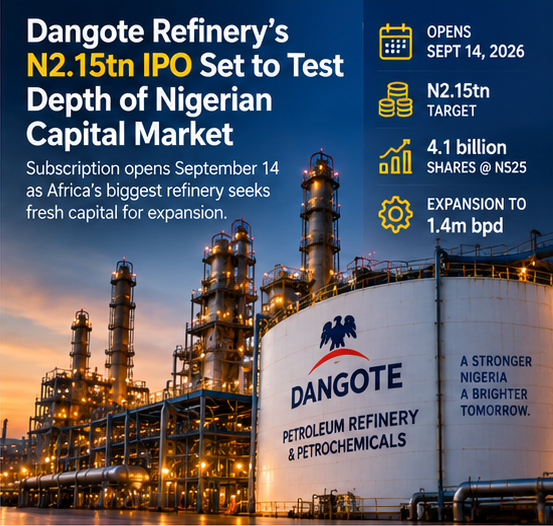
Nigeria’s capital market is preparing for one of its biggest tests yet as the Dangote Petroleum Refinery and Petrochemicals IPO moves towards its September 14 subscription opening.
The Securities and Exchange Commission has approved the refinery’s proposed offering of 4.1 billion ordinary shares at N525 each, potentially raising approximately N2.15 trillion if fully subscribed.
Reuters estimates the transaction at roughly $1.6 billion, positioning it to become Africa’s largest-ever share sale.
The scale of the transaction means its significance extends beyond Dangote Refinery.
A successful offering could demonstrate the ability of Nigeria’s capital market to mobilise enormous pools of domestic and international capital for large industrial projects.
September 14 Opening Approaches
The IPO order book is expected to open on Monday, September 14.
The refinery currently has about 120.13 billion existing shares registered, while the offer involves 4.1 billion shares.
Reuters reported that approximately $400 million of the transaction had already been underwritten.
The deal also includes a greenshoe provision that could permit additional shares equivalent to as much as 15 per cent of the offering if investor demand warrants it.
Dangote intends to use capital from the transaction to support a major expansion programme.
The refinery, which currently processes hundreds of thousands of barrels of crude daily, is targeting an eventual increase in capacity to approximately 1.4 million barrels per day.
Valuation Comes Under Investor Scrutiny
The transaction’s size is likely to focus attention on valuation.
Reuters reported that the offering implies a valuation of approximately $47 billion for the refinery, a figure that some analysts have questioned when compared with international refining companies.
That debate will form an important part of the investment decision.
Investors must weigh the refinery’s scale, Nigerian market dominance, expansion potential and strategic position against operational risks, energy-price volatility, financing requirements and its valuation relative to global peers.
The IPO also arrives at an unusual moment for the global energy industry, with oil prices again elevated amid geopolitical tensions and disruption to major shipping routes.
For the Nigerian Exchange, the transaction could significantly increase market capitalisation and add a major energy and industrial company to the investible universe.
It will also provide an important test of retail participation.
If successfully completed, the offer could establish a benchmark for other Nigerian companies considering large-scale public listings.