
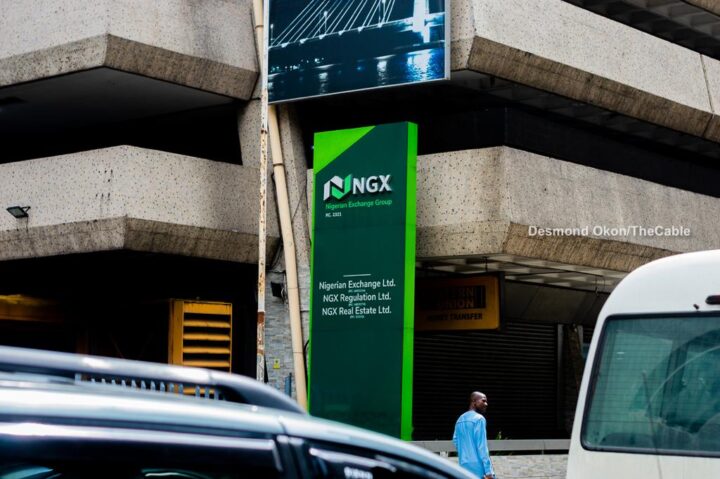
The Nigerian equities market returned to positive territory on Thursday, September 10, as renewed buying interest in major banking stocks lifted the Nigerian Exchange All-Share Index, ASI, by 0.06 per cent to 242,378.13 points.
Market capitalisation advanced at the same rate to N157.15 trillion, representing an increase of about N100 billion from the N157.05 trillion recorded in the preceding session.
The recovery also pushed the market’s year-to-date return slightly higher to 55.76 per cent, compared with 55.66 per cent previously, according to Coronation Research’s Daily Market Wrap for September 10.
The marginal rebound comes after a difficult run for Nigerian equities, with the market still down 1.87 per cent week-to-date despite its substantial gains since the beginning of 2026.
Banking Stocks Provide Support
The recovery was largely driven by selected financial stocks.
Access Holdings gained 5.66 per cent, while UBA advanced 2.21 per cent and GTCO rose 1.48 per cent, providing enough support to offset losses in several other counters.
Access Holdings closed at N28 after opening at N26.50, with approximately 28.57 million shares traded during the session.
GTCO rose from N128 to N129.90 on turnover of about 25.74 million shares, while Zenith Bank added 0.40 per cent to close at N124.50.
The performance was reflected in the NGX Banking Index, which advanced 0.69 per cent.
However, the sector remains down 4.75 per cent for the week, illustrating the volatility that has characterised the market’s recent correction.
Market Breadth Tells a Different Story
The headline increase in the ASI concealed considerable weakness beneath the surface.
A total of 30 stocks declined compared with 25 gainers, leaving market breadth negative at 0.83.
That means the market’s positive close was not the result of a broad-based rally.
Instead, gains in selected large and influential companies were sufficient to push the benchmark index higher even though more stocks lost value than gained.
The distinction is important because the ASI is weighted by market capitalisation. Strong movements in large companies can therefore have a greater effect on the index than declines in numerous smaller stocks.
Consumer, Industrial Stocks Remain Under Pressure
Sector performance reinforced the mixed nature of Thursday’s recovery.
The Consumer Goods Index fell 1.03 per cent, while Industrial Goods slipped 0.04 per cent and Insurance declined 0.42 per cent.
Oil and Gas, however, gained 0.79 per cent, while Banking was the other major sector finishing in positive territory.
International Breweries was among the major decliners, falling 9.80 per cent to N9.20.
Champion Breweries dropped 9.91 per cent, while RT Briscoe lost the maximum 10 per cent during the session.
The market therefore remains divided between investors taking positions in selected heavyweight stocks and continued selling across other areas.
Strong 2026 Performance Remains Intact
Despite recent volatility, the broader picture for Nigerian equities remains substantially positive.
The ASI’s 55.76 per cent year-to-date gain shows that investors who entered the market at the beginning of 2026 have, at the index level, retained significant gains.
Several individual stocks have performed even more strongly.
SCOA had gained 365.49 per cent year-to-date as of Thursday’s close, while Union Dicon was up 244.20 per cent, Berger Paints 207.50 per cent and First HoldCo 183.92 per cent. Airtel Africa and Seplat were also up 177.53 per cent and 156.63 per cent respectively.
Thursday’s recovery consequently provides some relief following the recent sell-off, but the negative market breadth indicates that investor confidence has not yet returned across the entire market.
Whether the rebound develops into a broader recovery will depend on whether buying interest spreads beyond a limited number of large-cap stocks in subsequent sessions.