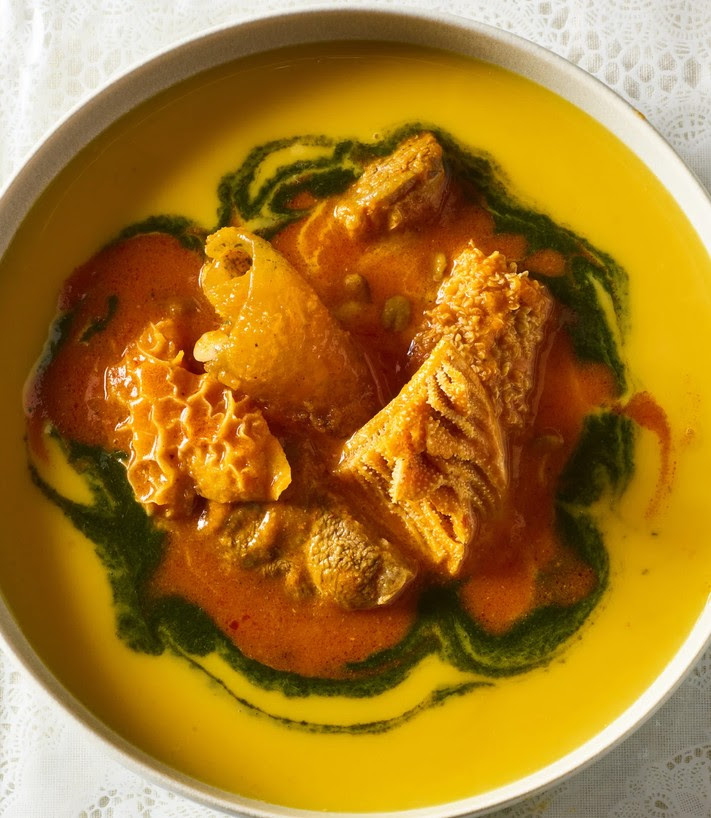
From the smoky flavours of suya to a cold glass of zobo and the enduring West African debate surrounding jollof rice, Nigerian cuisine contains stories that extend far beyond the country’s borders.
Culinary researcher and author Ozoz Sokoh is documenting those connections through her cookbook, Chop Chop: Cooking the Food of Nigeria, examining how ingredients, cooking techniques and familiar Nigerian dishes reflect centuries of trade, migration and cultural exchange.
The book explores foods including imoyo, ewedu, jollof rice, zobo, suya, small chops, Chapman and chicken curry, placing Nigerian cooking within a broader international culinary conversation.
Rather than presenting Nigerian cuisine as something that developed in isolation, Sokoh traces connections with food traditions found elsewhere in Africa and across the Atlantic.
Imoyo Finds Connection With Brazil
One example is imoyo, a Nigerian fish stew.
Sokoh identifies similarities between the dish and Brazil’s molho, drawing attention to culinary connections that can emerge when ingredients and food traditions move between societies.
Nigeria’s relationship with parts of the Americas has been shaped by centuries of human movement and cultural exchange, and food can preserve traces of those histories long after their origins become less obvious.
The similarities explored in Chop Chop allow familiar dishes to be viewed as records of those interactions.
Ewedu Goes Beyond Nigeria
Another example is ewedu, the jute leaf used in one of southwestern Nigeria’s most recognisable soups.
While deeply embedded in Nigerian food culture, jute leaves are not unique to Nigeria.
Sokoh notes their presence in food traditions in North Africa and Southeast Asia, demonstrating how a familiar Nigerian ingredient can simultaneously belong to a much wider culinary geography.
That perspective challenges assumptions that similarities between cuisines necessarily mean one culture copied another.
Ingredients travel. Communities migrate. Trade introduces new crops. Cooking methods evolve as people adapt what is available to local tastes.
Food consequently becomes evidence of cultural exchange.
Jollof Tells West Africa’s Shared Story
Few dishes demonstrate regional culinary identity more clearly than jollof rice.
Nigeria has made jollof a major part of its popular food culture, but the dish reflects centuries of trade and cultural interaction across West Africa.
Its regional character is one reason debates about which country prepares the “best” jollof can become so passionate.
Behind the friendly rivalry lies a shared culinary tradition crossing modern national borders.
Sokoh’s approach therefore places jollof within a longer history rather than treating it simply as a contemporary national dish.
Zobo Connects Nigeria With Caribbean and Mexico
Perhaps one of the clearest international connections is zobo.
The deep-red hibiscus drink consumed across Nigeria has close relatives elsewhere.
In the Caribbean, a related beverage is commonly known as sorrel, while Mexico has agua de Jamaica.
Different societies add their own ingredients and preparation methods, but the presence of hibiscus-based drinks across several regions provides another illustration of how food traditions cross oceans and borders.
For Nigerian consumers, zobo may feel completely local. Viewed internationally, however, it becomes part of a much broader family of drinks.
Suya, Small Chops and Chapman Tell Other Stories
Sokoh’s exploration extends to suya, small chops, Chapman and chicken curry, demonstrating the diversity within Nigerian cuisine itself.
Nigeria’s food culture reflects differences in geography, ethnicity, religion, migration and contact with other societies.
That makes it difficult to reduce Nigerian food to one set of ingredients or a handful of internationally recognised dishes.
The country’s cuisine instead represents overlapping traditions continually adapting to changing tastes and influences.
Nigerian Cuisine Gains Wider Audience
The international attention surrounding Nigerian food also reflects the broader global visibility of Nigerian culture.
Music, film, fashion and literature have introduced international audiences to contemporary Nigeria, while food provides another route into the country’s history and everyday life.
Sokoh’s work adds documentation and historical context to that expansion.
Rather than simply offering recipes, Chop Chop provides a framework for understanding why Nigerians eat what they eat and how those dishes connect with people elsewhere.
That perspective makes the kitchen another archive of history.
A bowl of ewedu, plate of jollof or glass of zobo can reveal stories about migration, trade, agriculture and cultural adaptation.
As Nigerian cuisine reaches a wider international audience, Sokoh’s work suggests that its global appeal does not require stripping away its local identity.
Instead, understanding the connections behind the dishes can make the Nigerian food story even richer.