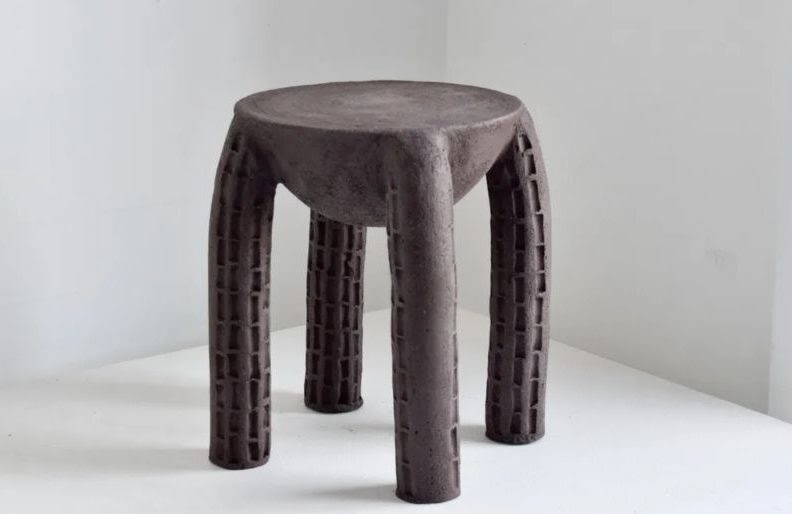
For Spanish-Equatorial Guinean ceramicist Bisila Noha, clay has become more than a material for producing decorative objects. It is a medium through which she examines African heritage, migration, identity and the generations of women whose labour has shaped ceramic traditions without always receiving corresponding recognition.
Noha, who left her previous career to pursue ceramics in 2016, has developed an artistic practice shaped by research, travel and residencies, including experiences in Nigeria and Senegal where she studied longstanding ceramic traditions and the role women have played in sustaining them.
Her work connects contemporary artistic practice with questions about who produces cultural knowledge, whose contributions are preserved and how traditional materials can tell stories about identity across generations and continents.
Clay Becomes a Link to Equatorial Guinea
One of the strongest examples of that approach is Noha’s “Baney Clay” series.
The project combines clay collected from her father’s village in Equatorial Guinea with porcelain, creating a material expression of her dual cultural identity.
The contrast between the materials allows Noha to use ceramics as a means of exploring belonging and heritage rather than treating clay solely as a functional medium.
Her Spanish and Equatorial Guinean background consequently becomes embedded within the physical composition of the work.
Clay from a specific African community carries geographical and familial meaning, while its combination with porcelain creates a conversation between different materials and aspects of the artist’s identity.
That process demonstrates how contemporary African and diasporic artists are increasingly using materials themselves as part of the narrative.
Research Takes Noha Across Africa
Noha’s engagement with African ceramics has also involved research into pottery traditions beyond her own family background.
Residencies and research in Nigeria and Senegal exposed her to generations of ceramic knowledge and, particularly, the contribution women have made to those traditions.
Her work consequently examines community and feminism alongside questions of cultural heritage.
The emphasis on women is important to Noha’s artistic practice.
Traditional craft can become closely associated with the communities or societies from which it originates while the individual women responsible for maintaining techniques, teaching younger generations and producing objects receive comparatively little recognition.
Noha’s work attempts to bring that labour back into the conversation.
Recovering the Story of Kouame Kakahá
That effort becomes particularly explicit in another of her projects, “Searching for Kouame Kakahá.”
The project investigates the work and legacy of a female Ivorian potter whose contribution had been overlooked.
Rather than simply borrowing visual inspiration from traditional ceramics, Noha uses the project to question the processes through which some artistic legacies are documented while others disappear from mainstream accounts of art history.
The project therefore sits at the intersection of art and historical recovery.
By searching for the story of an overlooked female ceramicist, Noha draws attention to the wider issue of women whose creative contributions survive through techniques and objects even when their individual names receive little recognition.
Benin Bronze Tradition Inspires New Work
Noha’s recent practice also draws inspiration from Benin’s lost-wax bronze tradition, which she uses as a metaphor for hidden female labour.
The reference expands her practice beyond ceramics into a broader investigation of African artistic traditions and the people involved in sustaining them.
Lost-wax casting involves a process in which an initial model ultimately disappears as part of creating the finished object.
Within Noha’s artistic framing, that process provides a powerful metaphor for labour that contributes to a final cultural object but can become invisible once the work is completed.
Her interpretation brings questions of gender and recognition into a conversation about artistic production.
‘A Tactile Story’ Goes to Milan
Noha’s work is currently being presented through “A Tactile Story” at Casa Tacchini in Milan, where expressive vessels and sculptural pieces are displayed alongside furniture.
She has also been named a recipient of the Tacchini Prize, marking another stage in the international recognition of her work.
The Milan presentation gives audiences an opportunity to encounter objects rooted partly in African histories within an international contemporary design setting.
Yet the central themes remain closely connected to heritage and memory.
For Noha, ceramics provide a way of tracing movement between places, generations and identities while questioning why certain contributors to cultural traditions become celebrated and others remain largely invisible.
Her practice demonstrates how an everyday material such as clay can carry complex stories about family, migration, gender and history.
By combining traditional research with contemporary artistic expression, Noha is not simply preserving African ceramic influences. She is using them to ask who gets remembered, whose labour receives recognition and how a new generation of artists can revisit inherited traditions without separating them from the people who created them.