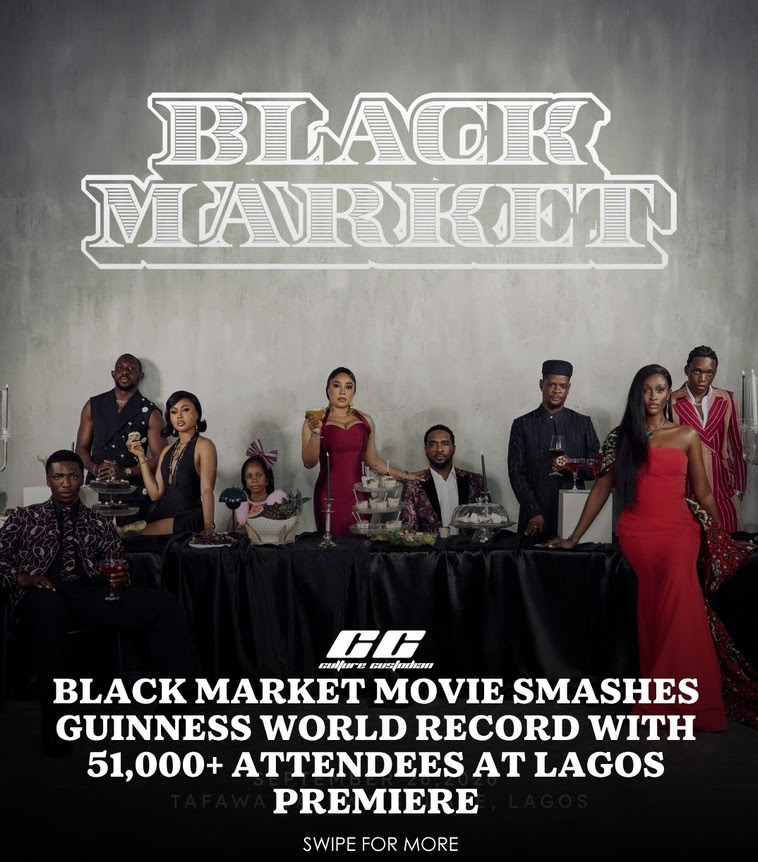
Nigeria’s film industry has recorded another landmark moment after more than 50,000 people gathered at Tafawa Balewa Square (TBS), Lagos, for the screening of Fatimah Binta Gimsay’s crime thriller, Black Market, surpassing the previous attendance record for a film screening at a single location.
The September 26, 2026 event attracted an audience exceeding the previous benchmark of about 43,000 attendees, positioning the production at the centre of an ambitious attempt to demonstrate the enormous audience and cultural reach of Nollywood.
The scale of the gathering represented a significant achievement for a Nigerian production and highlighted Nollywood’s ability to mobilise audiences beyond traditional cinemas and streaming platforms.
But the historic turnout also generated criticism.
Attendees raised concerns about crowd management, transportation difficulties, poor audio and periods when the screen reportedly went blank, creating a debate over whether the scale of the record attempt was adequately matched by the quality of the viewing experience.
‘Black Market’ Tells Story of Five Market Women
Written by Abdul Tijani-Ahmed and Fatimah Binta Gimsay, Black Market is a crime thriller centred on five market women involved in a sophisticated cross-border smuggling operation.
Their carefully concealed operation is disrupted when one of their daughters is kidnapped.
The development forces the women to abandon the secrecy that had protected their network and embark on a dangerous rescue mission, providing the central conflict around which the story develops.
By placing market women at the centre of a crime thriller, the film draws from a recognisable element of Nigerian economic and social life while moving its characters into the less conventional territory of organised cross-border crime.
The production also adds to the growing range of stories emerging from Nollywood as filmmakers explore genres extending beyond the romantic dramas and comedies traditionally associated with popular Nigerian cinema.
More Than 50,000 Gather at TBS
The most striking element of the Black Market project, however, has become the sheer size of its public screening.
More than 50,000 people were reported to have attended the September 26 event at Tafawa Balewa Square, one of Lagos’ most prominent public spaces.
The turnout surpassed a previous record of approximately 43,000 people for a film screening at a single location.
Bringing such a large audience together for one Nigerian film illustrates the potential scale of domestic interest available to Nollywood producers when cinema is transformed from an individual viewing experience into a major public event.
It also provides another indication of the cultural influence of Nigeria’s creative sector.
Nollywood productions already reach audiences across Africa and within the African diaspora through cinemas, television and streaming services. Large-scale physical events potentially provide filmmakers with another way of turning movie releases into cultural experiences.
Record Accompanied by Complaints
The achievement was not without problems.
According to the account provided, complaints emerged over crowd management, transportation, poor audio and a blank screen during the event.
Those concerns have complicated the celebration surrounding the attendance figure and triggered questions over whether sufficient logistical preparation accompanied the effort to bring tens of thousands of people together for a single screening.
The concerns are particularly relevant because large public entertainment events require considerably more than attracting an audience.
Security, entry and exit routes, transportation, sound quality, visibility, emergency response and crowd movement all become increasingly important as attendance rises.
A record crowd therefore creates both an opportunity and an operational challenge.
For Nigeria’s entertainment industry, the lessons from TBS could prove useful if producers and promoters increasingly seek to organise screenings, concerts and other cultural events on a similar scale.
Debate Over Record Versus Viewing Experience
The problems surrounding the event have also produced a broader discussion about what should define its success.
The source material notes that some observers questioned whether attendance was motivated more by the record attempt than enthusiasm for the film itself.
That distinction matters when assessing the commercial and cultural impact of the event.
A large gathering demonstrates an ability to mobilise an audience, but the longer-term success of a film also depends on how viewers respond to its storytelling, performances, production quality and overall cinematic experience.
Observers have consequently argued that the record can be celebrated while the film and the organisation of the screening remain open to critical assessment.
Such criticism does not necessarily diminish the significance of gathering more than 50,000 people around a Nigerian film. Instead, it highlights the difference between achieving a major promotional milestone and delivering an equally strong audience experience.
Nollywood Tests New Ways to Reach Audiences
The Black Market screening also raises interesting questions about how Nigerian filmmakers can connect directly with audiences.
Cinema distribution remains an important component of the industry, while streaming platforms have significantly expanded access to Nigerian productions internationally.
Large public screenings offer another model.
They can turn film premieres into mass entertainment events while potentially providing opportunities for sponsorship, tourism, merchandising and other activities around a production.
However, the experience at Tafawa Balewa Square demonstrates that scaling an audience also means scaling infrastructure and planning.
The bigger the crowd, the greater the pressure on sound systems, screens, transportation arrangements, security personnel and other facilities required to deliver the event successfully.
Record Adds Another Chapter to Nollywood’s Growth
Whatever debate surrounds the organisation of the screening, attracting more than 50,000 people to a single location for a Nigerian film represents a notable milestone.
It demonstrates the scale at which Nollywood can generate public attention and reinforces the industry’s position as an important component of Nigeria’s creative economy and cultural influence.
For Gimsay and the team behind Black Market, the TBS event has ensured that the film’s story now extends beyond what happens on screen.
The production has become part of a wider conversation about Nollywood’s audience power, the possibilities of large-scale film events and the infrastructure required to convert enormous crowds into memorable cinematic experiences.
The challenge going forward will be to ensure that future attempts to match or surpass the attendance milestone combine the excitement of setting records with the technical and logistical standards audiences expect from major entertainment events.