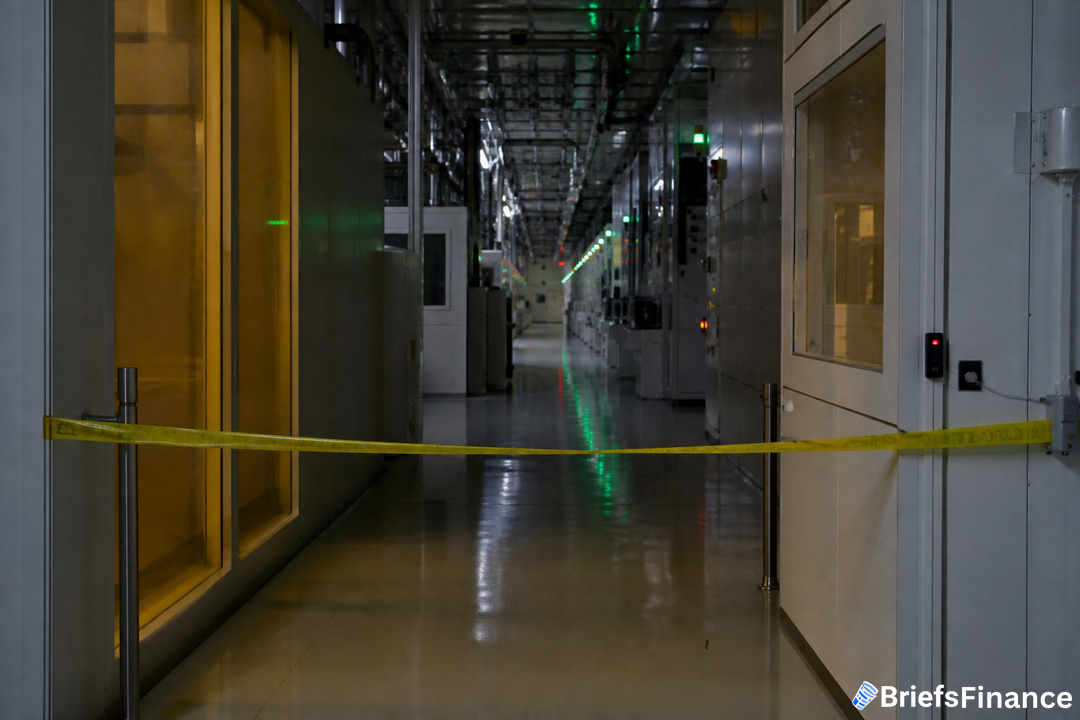
Global equity losses deepened as semiconductor stocks fell sharply in the United States and Asia, extending a retreat from the artificial intelligence-driven rally that had supported technology markets.
According to the supplied Bloomberg market report, MSCI’s Asia-Pacific equities gauge dropped 2.8 per cent, putting it on course for its lowest close since July.
South Korea’s Kospi index, a key market indicator for the global semiconductor and artificial intelligence trade, fell as much as 8 per cent, triggering a brief trading halt.
Samsung Electronics and SK Hynix, two major semiconductor manufacturers, both recorded losses of more than 10 per cent.
US technology futures also weakened, with Nasdaq 100 contracts falling 0.9 per cent, while European stock futures pointed to a decline of approximately 1 per cent at the opening.
Inflation worries weigh on technology shares
The selloff followed a rise in US inflation to its fastest pace in five months, according to the supplied report.
The inflation reading prompted traders to increase bets on further Federal Reserve interest-rate hikes, even as investors considered the possibility that officials could leave rates unchanged at their October meeting.
Higher interest rates can pressure equity valuations by increasing the discount rate applied to future corporate earnings and making safer assets more attractive relative to stocks.
Technology companies, particularly those whose valuations rely heavily on expectations of future growth, can be especially sensitive to shifts in interest-rate expectations.
Semiconductor stocks face renewed pressure
The losses in South Korea highlighted the vulnerability of markets heavily exposed to semiconductor manufacturing and the AI investment cycle.
Samsung Electronics and SK Hynix are important suppliers in the global memory-chip market, including components used in data centres and advanced computing systems.
The sharp declines suggest investors were reassessing the risks surrounding high valuations and the pace of future technology-sector growth.
However, a market selloff does not by itself establish that demand for artificial intelligence infrastructure is weakening. Investors will continue to assess company earnings, capital expenditure plans, chip demand and the returns generated by AI-related investment.
Treasuries recover as investors seek safety
US Treasury securities initially declined following the inflation data but later recovered, supported by demand for safe-haven assets and the attraction of yields near multiyear highs.
Bond prices and yields move in opposite directions, meaning stronger demand for existing Treasuries generally pushes their prices higher and yields lower.
The US dollar weakened during the market movements described in the report, while equity futures pointed to further pressure on technology shares.
Markets weigh inflation against growth prospects
The latest market moves reflect the competing forces shaping global investment decisions: inflation, interest-rate expectations, corporate earnings and geopolitical uncertainty.
For investors, the immediate focus is likely to remain on incoming economic data and central-bank guidance, particularly any signals about the direction of US monetary policy.
For technology companies, the challenge is to demonstrate that spending on AI infrastructure can generate earnings sufficient to justify investment expectations.
The supplied market report describes a broad risk-off move, but the direction of markets will depend on subsequent economic releases, corporate results and policy decisions.