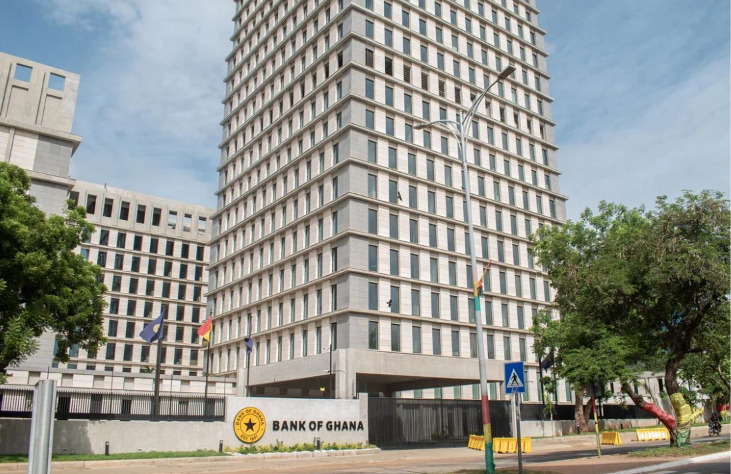
The Bank of Ghana has reduced its benchmark monetary policy rate from 14 per cent to 11 per cent, marking a significant adjustment in the country’s monetary policy direction.
The decision was announced on November 18, 2026, following the central bank’s 133rd Monetary Policy Committee meeting held between November 16 and 18.
The 300-basis-point reduction brings the policy rate to its lowest level following improvements in liquidity management, easing inflationary pressures and stronger economic conditions.
Governor of the Bank of Ghana, Dr Johnson Pandit Asiama, announced the decision during the Monetary Policy Committee briefing in Accra.
He explained that the adjustment was intended to align the policy rate with prevailing money market conditions.
According to the governor, improvements in monetary operations have strengthened liquidity management and allowed market interest rates to move below the previous 14 per cent policy rate.
The central bank also introduced changes to its monetary policy operations to improve the transmission of interest-rate decisions to the wider financial system.
One of the adjustments involved replacing the 14-day Open Market Operations instrument with a seven-day instrument.
The bank also narrowed its monetary policy corridor from plus or minus 400 basis points to plus or minus 100 basis points around the benchmark rate.
These adjustments are expected to improve liquidity management and keep market interest rates closer to the policy rate.
Economic growth also supported the decision.
According to the governor, Ghana’s Composite Index of Economic Activity increased by 7.7 per cent year-on-year in September 2026.
The improvement was supported by private-sector credit, exports, tourist arrivals and construction activities.
The country’s fiscal position also recorded progress during the period.
Provisional figures showed that Ghana’s overall fiscal deficit stood at one per cent of Gross Domestic Product during the first 10 months of 2026, compared with a target of three per cent.
The country also recorded a primary surplus of 1.4 per cent of GDP.
Public debt stood at GH¢759.3 billion, equivalent to 47.5 per cent of GDP, in October 2026.
Despite the positive developments, inflation remains an important consideration for the central bank.
Headline inflation increased slightly to 5.7 per cent in October from 5.2 per cent in September.
The increase was largely associated with non-food inflation, which rose to 7.9 per cent following higher utility tariffs and crude oil prices.
However, food inflation declined to 2.9 per cent, supported by improved food supply.
The central bank indicated that inflation remained below the lower boundary of its medium-term target band, although it expects inflation to gradually return towards the target.
The country’s banking sector also recorded improvements.
Total banking-sector assets increased by 21.2 per cent to GH¢512.9 billion, while the capital adequacy ratio improved to 18.5 per cent.
The non-performing loan ratio also declined to 13.1 per cent from 19.5 per cent a year earlier.
Ghana’s external position showed further improvement, with the trade surplus reaching $13.08 billion during the first 10 months of 2026.
Gold exports accounted for approximately 67 per cent of total export earnings.
International reserves stood at $12.1 billion as of November 17, equivalent to approximately 4.4 months of import cover.
The interest-rate reduction could create opportunities for businesses and individuals if commercial banks gradually adjust their lending rates.
Lower borrowing costs could encourage investment, support business expansion and improve access to credit.
However, the policy rate reduction does not automatically mean that commercial banks will immediately reduce the interest rates charged to customers.
Banks will continue considering funding costs, credit risks and prevailing economic conditions when determining lending rates.
For Ghana, the latest decision represents an important step in its efforts to support economic activity while maintaining price stability.