Abuja Electricity Distribution Plc (AEDC) has unveiled new digital platforms designed to improve electricity service delivery, protect customer information and strengthen transparency, while reaffirming its commitment to progressively eliminate estimated billing across its franchise area.
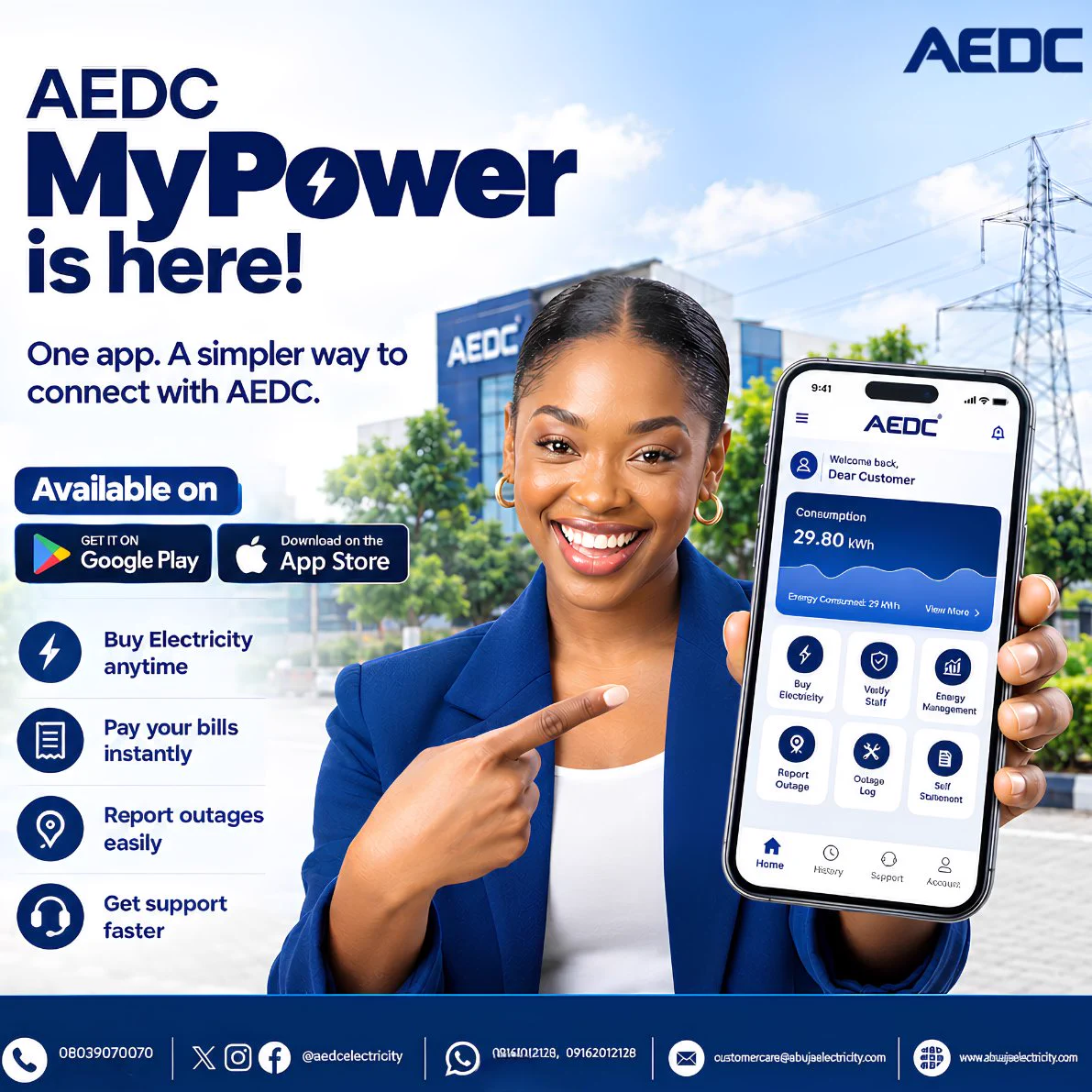
The electricity distribution company introduced the AEDC MyPower Mobile and Web applications in Abuja as part of its broader digital transformation programme aimed at improving customer experience and operational efficiency.
Chief Executive Officer of AEDC, Chijioke Okwuokenye, said the platforms were developed to give customers greater control over electricity-related transactions and provide more convenient access to essential services.
According to him, the initiative is focused primarily on improving customer satisfaction rather than simply reducing operational costs.
The applications will enable consumers to purchase electricity tokens, settle bills, report outages, lodge complaints, monitor energy consumption and manage multiple electricity accounts.
The company also assured customers that their personal information would be protected within the digital environment.
MyPower Platforms Expand Customer Services
Okwuokenye explained that the new applications were designed to reduce the difficulties customers encounter when accessing electricity services.
Under the new arrangement, consumers can perform several transactions remotely without necessarily visiting a physical customer service centre.
The platforms provide access to electricity token purchases, bill payments, payment receipts and account information.
Customers can also submit service complaints and track their progress.
For consumers managing more than one electricity meter or property, the applications are designed to support multiple accounts.
This could be particularly useful for landlords, business operators and organisations responsible for electricity payments across different locations.
The digital services are expected to improve convenience and provide customers with clearer records of their transactions.
AEDC Targets Improved Outage Communication
One of the major features highlighted by the company is improved communication about electricity interruptions.
Okwuokenye explained that customers would be able to access information that could help them understand whether an outage was associated with a feeder, transformer or another part of the distribution network.
Electricity interruptions often create uncertainty for consumers, particularly when information about the cause or expected restoration is unavailable.
Improved communication could help households and businesses plan their activities during service disruptions.
It could also reduce repeated complaints by providing customers with relevant information about network conditions.
However, the usefulness of the feature will depend on the accuracy and timeliness of information supplied through the platforms.
Company Reaffirms Commitment to End Estimated Billing
AEDC also pledged to progressively eliminate estimated billing within its service territory.
Estimated billing remains a major concern among electricity consumers who do not have functioning prepaid or other approved metering arrangements.
Under estimated billing, customers may receive charges calculated through an approved estimation methodology rather than direct measurement of their individual electricity consumption.
Disputes can arise when consumers believe that the estimated charges do not reflect the electricity supplied or consumed.
Okwuokenye’s commitment signals the company’s intention to improve billing transparency.
However, eliminating estimated billing will require sustained progress in customer metering, accurate consumption records and compliance with applicable electricity regulations.
The launch of digital applications alone will not resolve the metering gap.
Data Protection Becomes Important
As electricity distribution companies expand digital services, the protection of customer information becomes increasingly important.
Digital platforms may process personal details, electricity account information, consumption records and payment-related data.
Customers therefore require assurance that their information will be handled securely and used appropriately.
AEDC pledged to protect consumers’ personal information as it expands its digital operations.
Effective data protection will require appropriate technical safeguards, access controls and compliance with relevant privacy obligations.
The company will also need to maintain secure payment arrangements and provide reliable channels for customers to report suspected account problems.
Digitisation Could Improve Customer Relationships
According to Okwuokenye, one of AEDC’s longstanding challenges has been understanding customer needs and developing appropriate solutions.
The company believes digital platforms can help bridge this gap by improving communication and providing more structured information about service requests.
For example, complaint records could help identify recurring network problems and areas where customers experience persistent service interruptions.
Energy consumption information may also help consumers understand their usage patterns.
Businesses could use such information to review operating costs and make better decisions about electricity consumption.
However, digital access must be complemented by reliable physical infrastructure and responsive customer service.
Customers Expect Measurable Improvements
The introduction of MyPower represents another step in the digital transformation of electricity distribution services.
For customers, the most important benefits will be faster transactions, clearer billing information and more effective complaint resolution.
The company will also be expected to demonstrate progress towards its commitment to eliminate estimated billing.
As the platforms become operational, their performance will be measured by reliability, ease of use, data security and the quality of customer support.
AEDC maintained that the initiative is intended to build a more transparent and responsive relationship with electricity consumers while supporting improvements in overall service delivery.