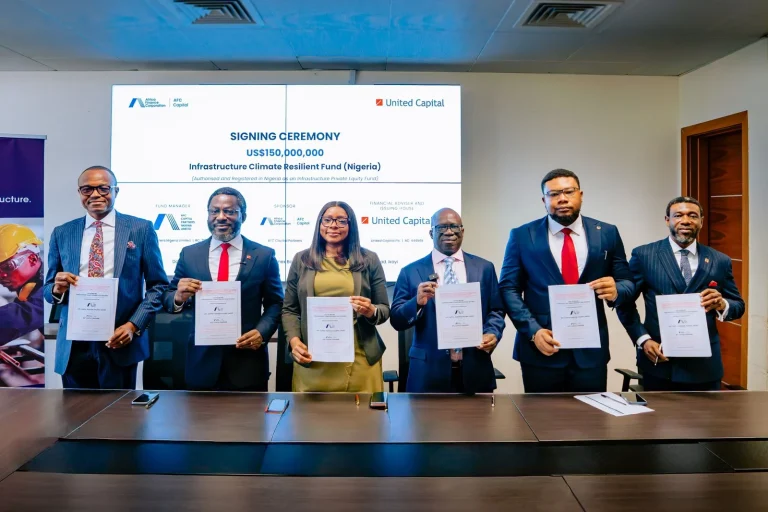
AFC Capital Partners, the asset management subsidiary of Africa Finance Corporation (AFC), has launched its $150 million Infrastructure Climate-Resilient Fund (ICRF) in Nigeria following regulatory approval from the Securities and Exchange Commission (SEC).
The formal signing ceremony, held in Lagos on Monday, established the SEC-registered closed-end investment vehicle to channel domestic institutional capital into critical green and climate-resilient infrastructure projects across Nigeria.
The Nigerian fund forms part of a larger $750 million pan-African climate initiative and is expected to help unlock investments from pension fund administrators, insurance companies and sovereign wealth funds, targeting an overall project financing pool of $3.7 billion.
Speaking with journalists at the event, Chief Financial Officer of AFC Capital Partners Nigeria Limited, Chika Dotimi-Beke, said the immediate priority is to raise capital and onboard institutional investors.
She said the fund is expected to make its first investment before the end of the year, with transport and renewable energy projects likely to receive priority once the Nigerian fund reaches its first close.
The Managing Director and Chief Executive Officer of Investment Banking at United Capital Plc, Gbadebo Adenrele, who serves as financial adviser and issuing house for the transaction, highlighted the depth of Nigeria’s domestic investment market.
According to Adenrele, Nigeria’s investment pool, particularly pension fund assets, is currently estimated at between N31 trillion and N32 trillion and continues to expand.
He said the opportunity was significant given Africa’s annual infrastructure financing gap, estimated at between $130 billion and $170 billion. He stressed that projects must be sufficiently de-risked to attract institutional investors, development finance institutions and commercial banks.
The climate-resilience focus of the fund comes as African economies face increasing losses from climate-related disruptions.
David Johnson, Chief Risk Officer at Africa Finance Corporation, said Africa suffers estimated annual losses of about $200 billion as a result of climate disruptions.
In Nigeria, he noted that flooding damages roads and causes severe traffic delays, while rising temperatures accelerate the deterioration of transport infrastructure.
Johnson also highlighted the impact of infrastructure weaknesses on the cost of goods, noting that transport costs account for nearly 40% of the cost of goods.
He said investment in resilient transport infrastructure could reduce logistics costs for businesses and consumers while providing competitive returns to investors.
To manage project execution risks and currency volatility, Johnson said the fund would maintain a diversified portfolio covering early-stage projects, mid-stage financing and mature operational assets.
Ayaan Adam, Chief Executive Officer of AFC Capital Partners, said the ICRF Nigeria provides institutional investors with a dedicated avenue to access high-yield, climate-resilient infrastructure assets.
She said combining institutional capital with AFC’s infrastructure expertise and blended finance could address the financing needs of critical infrastructure while helping African economies respond to the growing risks associated with climate change.
The fund is supported by the Green Climate Fund, which provides first-loss capital and technical assistance designed to reduce investment risks and attract additional private-sector financing.
AFC Capital Partners is an SEC-licensed asset manager registered in Mauritius and Nigeria. Its parent institution, Africa Finance Corporation, was established in 2007 and has deployed more than $20 billion across 36 African countries.