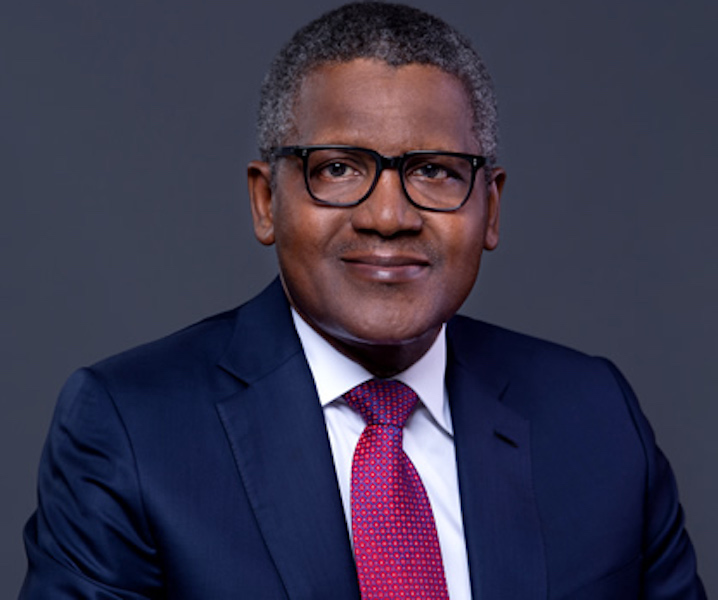
Africa’s richest man, Aliko Dangote, is considering Kenya as the preferred location for a proposed 650,000 barrels-per-day oil refinery in East Africa, shifting focus from an earlier plan to establish the facility in Tanzania.
Dangote disclosed this in an interview with the Financial Times, stating that he was leaning towards the Kenyan coastal city of Mombasa because of its deeper port infrastructure and larger consumer market.
The proposed refinery, estimated to cost between $15bn and $17bn, comes barely a year after the operational launch of the 650,000 barrels-per-day Dangote Refinery in Lagos, currently regarded as the world’s largest single-train refinery.
According to the report, the planned East African refinery would process crude oil from Uganda and other international suppliers while helping the region reduce dependence on imported petroleum products.
“Aliko Dangote, Africa’s wealthiest industrialist, is eyeing Kenya as the site of a huge 650,000-barrel-a-day oil refinery he intends to build in East Africa,” the report stated.
Dangote explained that Mombasa holds significant advantages over Tanga in Tanzania, which was previously considered for the refinery project tied to Uganda’s oil exports.
“I am leaning more towards Mombasa because Mombasa has a much larger, deeper port,” Dangote said.
“Kenyans consume more. It’s a bigger economy,” he added, noting that crude oil could be transported by ship rather than relying solely on the proposed 1,500-kilometre pipeline linking Ugandan oilfields to Tanzania’s Tanga port.
The billionaire industrialist stressed that the project’s success would largely depend on the support of the Kenyan government.
“The ball is in the hands of President Ruto. Whatever President Ruto says is what I’ll do,” Dangote stated, referring to William Ruto.
Recall that Dangote had earlier hinted at plans to replicate the Lekki-based refinery in East Africa during an infrastructure summit held in Nairobi last month, provided governments in the region offered the necessary support.
The refinery proposal has reportedly triggered diplomatic tensions between Kenya and Tanzania after President Ruto publicly announced plans for a refinery project in Tanzania without prior consultation with Tanzanian President Samia Suluhu Hassan.
According to the report, Hassan questioned why discussions about a refinery project in Tanzania became public without her knowledge.
“Why did you announce a refinery in Tanga, and I know nothing about it?” she reportedly asked during a private meeting with Ruto.
The report suggested that Dangote may be leveraging competition between Kenya and Tanzania to secure better investment conditions for the project.
However, Dangote insisted that Tanzania remains an option if unresolved issues surrounding the proposal are addressed.
“If they are able to sort themselves out,” he said, the refinery could still be located in Tanzania.
The development comes amid growing concerns over global fuel supply disruptions linked to tensions in the Middle East and temporary disruptions around the Strait of Hormuz.
The crisis has intensified calls for stronger refining capacity across Africa to reduce reliance on imported fuel products.
East African countries currently depend heavily on imported refined petroleum products, mostly sourced from the Middle East, leaving the region vulnerable to supply shocks and rising fuel prices.
Dangote emphasised that governments in the region must provide policy support and protection against unfair import competition for the refinery project to succeed.
“There is no refinery in the world that can survive without that protection,” he said.
According to him, cheap fuel imports from countries such as Russia and India could undermine refinery operations if governments fail to implement protective measures.
“If we have an agreement, we can start this year,” Dangote added.
The industrialist’s growing confidence follows the successful completion and operation of the $20bn Dangote Refinery located in the Lekki Free Zone in Lagos.
The refinery was completed after more than a decade of construction despite widespread doubts about whether a privately-owned African company could deliver a project of such scale.
A senior executive within the Dangote Group reportedly said the businessman now feels vindicated by the refinery’s technical and commercial success.
“Dangote feels vindicated, not only by succeeding technically in getting the refinery to work, but also succeeding commercially,” the executive stated.
The report noted that the Lagos refinery has reached full production capacity at a time when many countries are facing shortages of petrol, diesel and aviation fuel due to disruptions in global shipping routes.
Unlike several African countries, including Mauritius, Ethiopia and Zimbabwe, which reportedly introduced fuel rationing during recent supply disruptions, Nigeria has largely avoided widespread scarcity since the refinery ramped up operations.
The refinery has also become a major supplier of aviation fuel to international airlines facing shortages in Europe.
According to the report, Dangote has prioritised jet fuel supplies to Ethiopian Airlines, regarded as Africa’s largest airline.
Beyond petroleum refining, the facility has strengthened Nigeria’s fertiliser export capacity through Dangote’s urea plant, which currently produces about three million tonnes annually.
Another senior executive quoted in the report stated that recent geopolitical tensions in the Middle East had significantly boosted Dangote’s earnings.
“The Iran war, and the resulting closure of the Strait of Hormuz, has been ‘payday’ for Dangote’s business,” the executive reportedly said, adding that fertiliser prices and jet fuel margins had surged sharply.
Dangote also noted that global oil companies had benefited from the crisis.
“You can see all the other oil companies; their profitability has doubled. So you don’t expect us to do less,” he said.
A Nigerian entrepreneur, Dimieari Von Kemedi, said the refinery was already transforming Nigeria’s energy security landscape.
“Even if they close the Strait of Hormuz, it doesn’t concern us. We can produce and refine all the energy we need,” he stated.
Kemedi added that African nations were beginning to realise the risks of depending entirely on foreign markets for strategic commodities.
“It should not have taken the war in the Middle East to make that obvious,” he added.
President William Ruto also praised Dangote’s achievement, describing the Lagos refinery as proof that Africans can successfully execute large-scale industrial projects.
“Nigeria has been a producer of oil for all the years that we know. Yet, when you went to Nigeria, there were queues of people looking for fuel in petrol stations until one African stepped forward and built a refinery,” Ruto reportedly said.
Dangote further revealed plans to expand the capacity of the Lagos refinery from 650,000 barrels per day to 1.4 million barrels per day within the next 30 months.
According to him, the expansion would position the refinery among the largest refining operations globally.
“We’ll be price movers in the market,” Dangote said.
“If we don’t invest in our own continent, who else will?” he added.