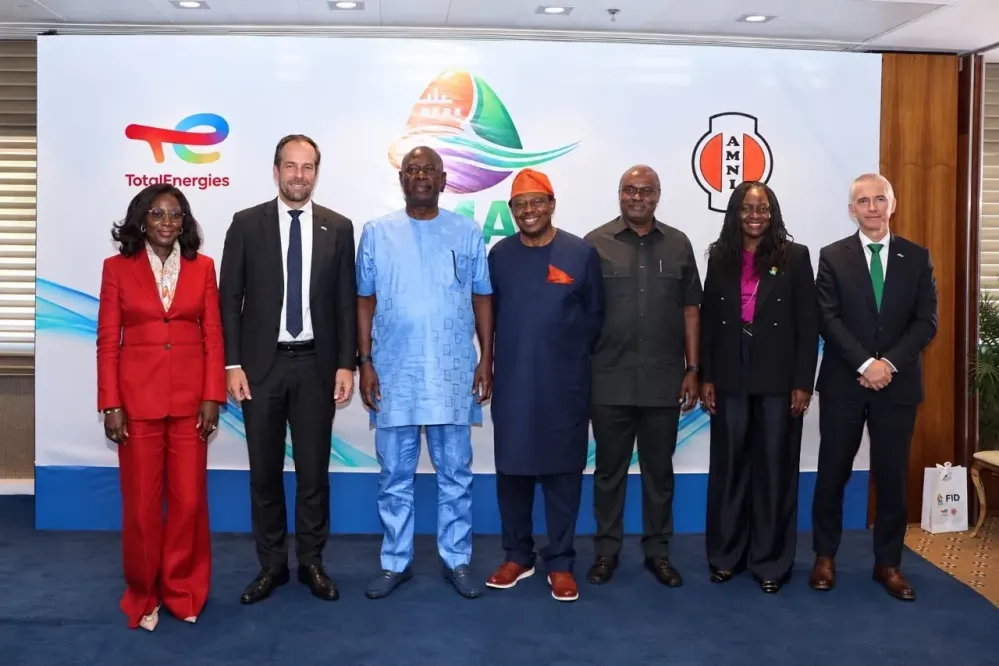
AMNI International and TotalEnergies have approved development of Nigeria’s offshore Ima gas project, advancing a new source of supply for the Nigeria LNG facility on Bonny Island.
The final investment decision was announced on September 23, 2026. TotalEnergies expects production to begin in 2028, although that remains a project target rather than a completed milestone.
The approval strengthens plans to supply NLNG’s Train 7 expansion. However, public announcements contain different investment and production figures, making clear attribution essential when describing the development.
Ima will supply the NLNG expansion
TotalEnergies says the field lies across offshore licences OML 112 and OML 117 in shallow water near Bonny Island. The company holds a 40 per cent interest and is the operator, while AMNI holds 60 per cent.
Its development plan includes a single platform and a 22-kilometre pipeline connection to Nigeria LNG. The company expects the field to supply about one-third of the gas required for the Train 7 expansion.
These details connect the upstream field development with a specific downstream customer. The value of the new production will depend partly on how effectively the supply infrastructure and the receiving facility operate together.
Public announcements give different project figures
NNPC Ltd described Ima as an $800 million investment. Its statement also put expected peak output at approximately 300 million standard cubic feet of gas a day.
TotalEnergies’ Nigerian business, by contrast, said the investment decision would unlock more than $650 million.
AMNI announced a $1.108 billion development and production of approximately 350 million standard cubic feet a day.
The international TotalEnergies release also gives a production plateau of 350 million cubic feet daily. The reviewed statements do not fully reconcile the differences in either investment value or output.
It would therefore be premature to combine these figures into a single definitive estimate. The companies and NNPC would need to explain whether they refer to different cost scopes, assumptions or measures.
Why additional gas matters for Train 7
NLNG says its Train 7 project will raise annual LNG production capacity from 22 million tonnes to 30 million tonnes. The expansion adds processing capacity at the Bonny Island complex.
In this setting, a train is a production unit used in the processing and liquefaction system. It is not a transport railway.
Additional processing capacity needs a dependable supply of natural gas. That is the role Ima is intended to support, alongside other sources feeding the facility.
Capacity should also be distinguished from actual output. A plant’s stated capacity describes what it is designed to produce under the relevant operating conditions. Annual production depends on gas supply, availability and other operating factors.
NNPC links the decision to sector reforms
NNPC attributed the investment decision to presidential directives introduced in 2024. It cited fiscal incentives for non-associated gas, faster contracting processes and lower development costs.
The state oil company described Ima as the fourth major gas project to reach a final investment decision under those measures, following Iseni, Ubeta and HI.
That is NNPC’s assessment of the reforms’ contribution. The announcement does not, on its own, quantify how much each measure changed the project’s economics or investment timetable.
For future projects, the broader test will be whether policy changes consistently help viable developments move from approval to construction and production.
Local participation and project delivery
TotalEnergies says the development will use Nigerian contractors and expects around 60 per cent of the workforce during development to come from host communities.
The company also describes design features including electricity supplied from shore and permanent methane monitoring. These are planned project characteristics, not independently verified operating results.
For local businesses and workers, the practical benefits will depend on contracts awarded, recruitment, training and the duration of work available.
The final investment decision is an important step, but construction and commissioning still lie ahead. Delivery against the expected 2028 start-up, clarification of the published figures and sustained gas supply to NLNG will provide clearer measures of the project’s progress.