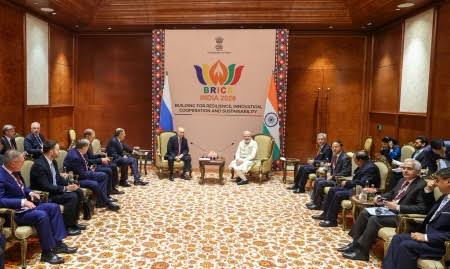
Leaders of the expanded BRICS grouping are meeting in New Delhi on Saturday for a high-stakes summit expected to focus on trade, investment, energy security and global conflicts as the organisation attempts to strengthen its influence over the international economic and political order.
Indian Prime Minister Narendra Modi is hosting Chinese President Xi Jinping, Russian President Vladimir Putin, Iranian President Masoud Pezeshkian and leaders from the other members of the 11-nation bloc.
The September 12-13 summit comes against an unusually difficult geopolitical backdrop, with the Russia-Ukraine war, the widening Middle East conflict and continuing tensions between Washington and Beijing testing the ability of BRICS countries to establish common positions.
BRICS Wants Bigger Global Role
BRICS began with Brazil, Russia, India and China before South Africa joined in 2010. Its subsequent expansion has brought Egypt, Ethiopia, Indonesia, Iran, Saudi Arabia and the United Arab Emirates into the grouping.
The enlarged bloc now includes major energy producers, some of the world’s largest emerging economies and countries representing a substantial share of the global population.
That expansion has increased BRICS’ economic weight.
It has also made political agreement more complicated.
Members have significantly different relationships with the United States and Europe, while some have their own bilateral disputes.
The summit will consequently test whether BRICS can move beyond presenting itself as an alternative voice for emerging economies and deliver practical economic cooperation.
India Pushes Digital Currency Link
One proposal attracting particular attention is India’s effort to link central bank digital currencies, CBDCs, across BRICS countries.
The proposal is designed to make cross-border payments faster and cheaper by improving interoperability between national digital currencies.
India has stressed that the plan is intended to facilitate payments rather than create a BRICS currency to replace the US dollar.
Political obstacles remain substantial.
Relations between some BRICS members are strained, while India itself has historically been cautious about deeper financial integration with China.
Iran and the UAE have also experienced serious tensions amid the Middle East conflict.
Global Financial Reform Back on Agenda
BRICS members are expected to continue pressing for reforms of international financial institutions to give emerging economies greater representation.
Reducing excessive dependence on Western-dominated financial infrastructure has also become a recurring objective.
Russia and Iran have particularly strong incentives to develop alternative payment mechanisms because of sanctions and restrictions affecting their access to international finance.
India’s position is more nuanced.
New Delhi maintains extensive relationships with Russia while simultaneously strengthening economic and strategic ties with the United States and Europe.
That balancing act could make Modi particularly important in shaping the summit’s final outcome.
The larger question is whether BRICS can transform its growing membership into coordinated economic power.
New members have made the organisation bigger.
The New Delhi summit will help determine whether they can also make it more effective.