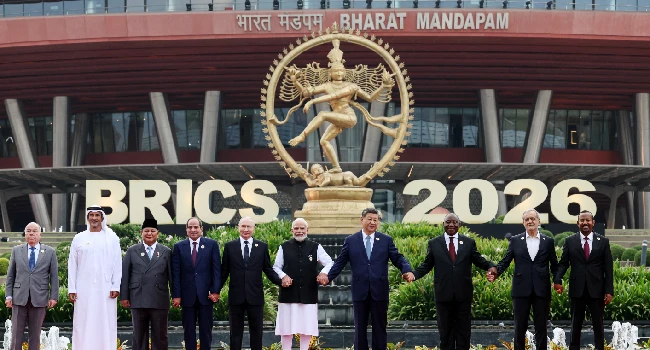
BRICS leaders have concluded their New Delhi summit with a renewed push for greater use of local currencies in international trade, reform of global institutions and deeper economic cooperation, as Indian Prime Minister Narendra Modi warned that geopolitical tensions and supply-chain shocks are increasingly threatening global stability.
The expanded 11-member grouping now represents roughly half of the world’s population and includes some of the world’s largest emerging economies and energy producers.
Modi warned that conflicts, climate disasters, pandemics and disruptions to supply chains can no longer be viewed as isolated regional problems because their economic consequences rapidly spread around the world.
He also raised concerns about what he described as the increasing weaponisation of technology and critical minerals.
BRICS Reaches Difficult Consensus
One of the summit’s notable achievements was simply producing a joint declaration.
BRICS includes countries with sharply different geopolitical interests, particularly amid the continuing Middle East conflict.
Nevertheless, the bloc agreed to express concern over conflicts in the Middle East and Sudan while advocating dialogue and diplomacy.
Members also criticised unilateral sanctions and coercive economic measures not authorised by the United Nations.
The agreement is significant because BRICS now includes countries such as Iran, Saudi Arabia and the United Arab Emirates, whose regional interests do not always align.
Reaching consensus demonstrates the bloc’s determination to maintain cohesion despite those differences.
Local Currencies Gain Attention
Financial cooperation remains another major objective.
BRICS backed greater use of local currencies in trade and stronger cross-border payment mechanisms.
That does not amount to creating a common BRICS currency.
Instead, members are attempting to reduce the cost and complexity of transactions between their economies while providing alternatives to financial infrastructure traditionally centred on Western markets and the US dollar.
China’s President Xi Jinping separately called for deeper economic integration under what he described as a broader BRICS cooperation framework, unveiling initiatives covering trade and artificial intelligence.
UN Reform Returns to Centre Stage
The summit also renewed demands for reforms to the United Nations and major international financial institutions.
Developing countries have long argued that institutions created after the Second World War no longer accurately reflect today’s global population and economic balance.
Reform of the UN Security Council is particularly important to African and other Global South countries seeking stronger representation.
BRICS also wants changes at institutions including the World Bank and International Monetary Fund.
Health, AI and Energy Added to Agenda
The grouping is simultaneously broadening cooperation beyond traditional diplomacy.
Members agreed to develop an integrated early-warning system for infectious diseases, designed to strengthen preparedness for future outbreaks.
Food security, energy, digital infrastructure, artificial intelligence and climate action also featured in the declaration.
China will assume the next BRICS chairmanship.
The challenge facing the bloc is now implementation.
Expansion has given BRICS greater demographic and economic weight, but size alone does not guarantee influence.
As Modi told fellow leaders, the agreements will matter only if they move from summit documents into tangible outcomes.