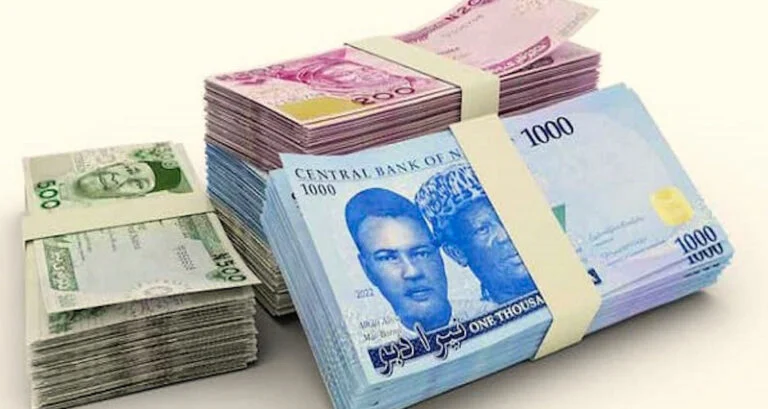
Cash held outside Nigeria’s banking system declined by N197.68bn in January 2026, even as overall liquidity in the economy weakened, according to the latest Money and Credit Statistics released by the Central Bank of Nigeria.
The data showed that currency outside banks fell from N5.41tn in December 2025 to N5.21tn in January 2026. Meanwhile, total currency in circulation recorded a marginal drop of N1.74bn to N5.731tn during the same period.
Despite the decline, a significant portion of cash remained outside the formal banking system, with 90.91 per cent of currency in circulation held outside banks in January. Although this represents an improvement from 94.33 per cent in December, it highlights the continued dominance of cash-based transactions in the economy.
On a year-on-year basis, cash outside banks rose by N473bn from N4.74tn recorded in January 2025, indicating sustained growth in physical cash usage. Similarly, total currency in circulation increased by N495.68bn within the same period.
Further analysis revealed that Nigeria’s broad money supply, also known as M3, declined by N1.05tn to N123.36tn in January 2026 from N124.41tn in December 2025. The contraction was largely driven by a significant drop in net foreign assets, which fell by N1.90tn to N29.61tn.
Net foreign assets—comprising foreign reserves and other external holdings of the banking system—also declined on an annual basis, dropping by N3.58tn compared to January 2025 levels.
The decline occurred alongside a strengthening of the naira in the official foreign exchange market. The currency closed January at N1,391 to the dollar, compared to N1,431 at the start of the month, reflecting improved market stability and liquidity conditions.
Analysts note that when the naira appreciates, the domestic value of foreign-denominated assets tends to decline when converted into local currency, contributing to reductions in overall money supply.
In contrast, domestic liquidity conditions expanded during the month. Net domestic assets rose by N850.76bn to N93.76tn, supported by increased lending and financial activity within the local economy. On a yearly basis, domestic assets grew by N15.83tn, underscoring stronger internal credit expansion.
Other monetary indicators showed mixed performance. Broad money components such as M2 declined by N1.05tn to N123.35tn, while narrow money—which includes cash and demand deposits—increased by N190.76bn to N42.33tn, reflecting improved transactional liquidity.
The movement in monetary aggregates comes amid the apex bank’s tight monetary policy stance aimed at controlling inflation and stabilising the foreign exchange market.
At its 304th meeting, the Monetary Policy Committee of the Central Bank of Nigeria, led by Governor Olayemi Cardoso, reduced the benchmark interest rate by 50 basis points to 26.5 per cent.
Cardoso said the decision followed a balanced assessment of economic risks and improving inflation trends. Headline inflation eased to 15.10 per cent in January 2026 from 15.15 per cent in December, marking the eleventh consecutive month of decline.
Food inflation dropped significantly to 8.89 per cent, while core inflation moderated to 17.72 per cent. On a month-on-month basis, inflation fell to -2.88 per cent, signalling a continued easing of price pressures.
The MPC also retained key policy parameters, including the Cash Reserve Requirement for deposit money banks at 45 per cent and maintained the Standing Facilities Corridor at +50/-450 basis points around the Monetary Policy Rate.
Experts have described the rate cut as a cautious but strategic move, aimed at reinforcing policy credibility rather than signalling a rapid shift to monetary easing.
Overall, the January figures indicate that while domestic economic activity and transactional liquidity showed resilience, declining foreign assets played a decisive role in reducing Nigeria’s overall money supply during the period.