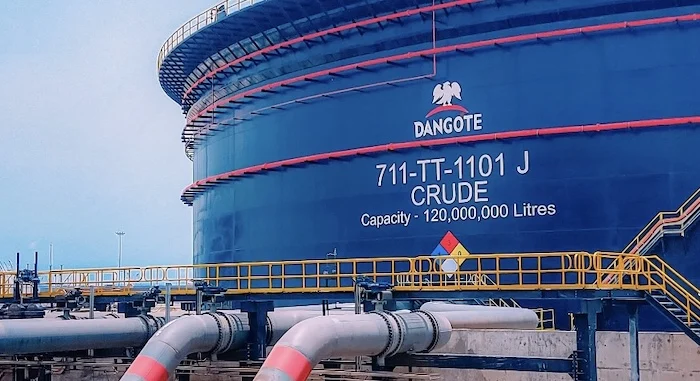
A new dispute has erupted in Nigeria’s downstream petroleum industry after the Dangote Petroleum Refinery moved to stop supplying petrol to major marketers it accuses of blending its locally refined product with imported fuel.
The decision has triggered opposition from petroleum marketers, who reject the blending allegation and warn that restricting access to locally produced petrol could create supply and distribution problems.
The disagreement opens another front in the debate over the role of imports and domestic refining in Nigeria’s deregulated petroleum market.
Dangote Targets Marketers Importing Fuel
According to the supplied report, the refinery’s position is that it will no longer supply petrol to marketers found to be blending Dangote-produced fuel with imported products.
The company is effectively drawing a line between marketers distributing its petrol and operators simultaneously handling imported fuel.
The allegation has been challenged by marketers.
PETROAN Rejects Blending Claim
National President of the Petroleum Products Retail Outlets Owners Association of Nigeria (PETROAN), Billy Gillis-Harry, described the allegation as unfounded.
“There is no reason why anyone would want to blend Dangote fuel with imported products. It is an unfounded allegation,” he said.
Gillis-Harry argued that Nigeria should instead encourage multiple supply sources.
Under that approach, Dangote would continue refining domestically while licensed importers could also bring products into the country.
Marketers argue that maintaining several supply channels supports competition and improves energy security.
Competition Versus Domestic Refining
The dispute highlights a larger question confronting Nigeria’s downstream sector.
The emergence of large-scale domestic refining has the potential to reduce dependence on imported petroleum products and retain more economic value within the country.
At the same time, deregulation is generally intended to create competition among suppliers.
If one supplier becomes overwhelmingly dominant, marketers may become concerned about pricing power and access to products.
The challenge for regulators is therefore balancing support for domestic refining with a competitive market capable of protecting consumers from supply disruptions and excessive concentration.
Supply Security Remains Critical
Petrol is one of Nigeria’s most economically sensitive commodities.
Disruptions can quickly affect transportation and the movement of goods, while price increases feed through to other areas of household expenditure.
Marketers’ warning about potential supply disruption is therefore significant.
However, the supplied material does not establish that a shortage has occurred as a result of Dangote’s decision.
The immediate issue remains a commercial dispute between the refinery and some marketers over product sourcing and the alleged blending of fuels.
Regulators Face Another Downstream Test
Nigeria’s downstream market has undergone a major transformation since the removal of the petrol subsidy and the expansion of domestic refining.
The new environment has created opportunities but also disputes over pricing, imports, distribution and competition.
Resolving the latest disagreement will require clarity around the refinery’s allegations and the commercial terms governing marketers purchasing its products.
For consumers, the desired outcome is straightforward: reliable availability of quality petrol at competitive prices.
How Nigeria balances those objectives while supporting local refining will remain one of the defining issues in the country’s evolving downstream petroleum market.