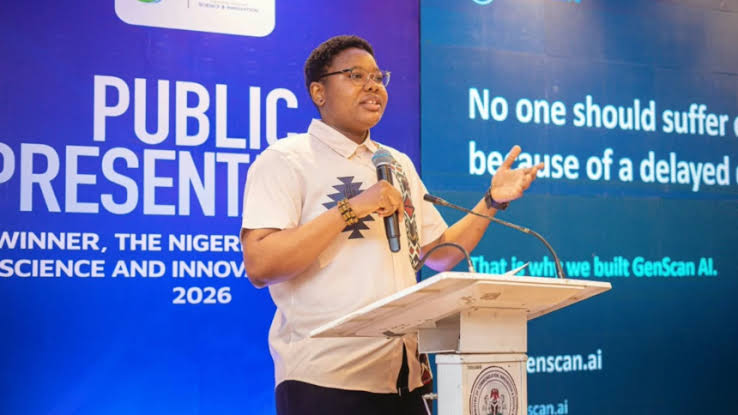
NLNG Limited has unveiled GenScan AI, an artificial intelligence-driven medical technology designed to shorten MRI scan times while maintaining or potentially improving diagnostic image quality, putting healthcare at the centre of Nigeria’s growing push to develop practical applications for artificial intelligence.
The technology was developed by Mary-Brenda Akoda and emerged as the winning entry in the 2026 Nigeria Prize for Science and Innovation.
GenScan AI was selected from a record 237 entries submitted under this year’s theme, “Innovations in Artificial Intelligence, ICT and Digital Technologies for Development.”
NLNG presented the technology to industry stakeholders in Abuja as attention increasingly shifts from the potential of artificial intelligence towards practical applications capable of addressing Nigerian development challenges.
AI Targets MRI Bottleneck
Magnetic Resonance Imaging provides detailed images used by doctors to examine organs, tissues and other internal structures.
However, MRI examinations can require patients to remain inside scanners for extended periods while images are collected.
Longer scan times can affect patient comfort while limiting how many examinations an MRI facility can perform during a working day.
GenScan AI seeks to address that problem by applying artificial intelligence to the imaging process.
According to information released around the innovation, the technology is designed to reduce MRI scan times without sacrificing image quality.
If the technology performs reliably in clinical environments, shorter examinations could allow imaging centres to handle more patients using existing equipment.
Technology Could Expand Diagnostic Capacity
That potential is particularly relevant in countries where advanced medical equipment is limited relative to population size.
Increasing the number of patients that can use an MRI scanner does not replace the need for additional healthcare infrastructure.
But greater efficiency could help existing machines serve more patients.
Shorter scan times could also improve the experience of people who find it difficult to remain still inside an MRI machine for prolonged periods.
The larger opportunity is therefore not simply faster imaging.
It is using software to increase the productivity of expensive medical infrastructure.
Record Entries Show Expanding Innovation Base
The 237 entries submitted for the 2026 prize also indicate growing interest in applying artificial intelligence, information technology and digital tools to development problems.
Nigeria’s technology ecosystem has historically received international attention primarily because of fintech.
Artificial intelligence is beginning to broaden that story.
Healthcare, agriculture, education and government services are increasingly being identified as sectors where locally developed AI systems could generate economic and social value.
The Federal Government has similarly been encouraging startups to look beyond financial technology, with NITDA identifying health-tech, agri-tech and ed-tech among areas where digital transformation could create new entrepreneurial opportunities.
Commercialisation Is Next Challenge
Winning an innovation prize, however, is different from deploying a medical technology at scale.
Healthcare products must demonstrate reliability and meet relevant clinical and regulatory requirements.
Developers also need partnerships with hospitals, imaging centres, healthcare professionals and potentially medical-equipment providers.
That means GenScan AI’s next important phase will involve moving from recognition and demonstration towards wider practical deployment.
Nigeria Needs More Locally Relevant AI
The project also raises a broader question about Nigeria’s artificial-intelligence ambitions.
Much of the current AI conversation is dominated by large global models developed outside Africa.
But the economic impact of artificial intelligence in Nigeria may ultimately depend on whether local researchers and businesses can adapt the technology to specific domestic problems.
GenScan AI represents one example of that approach.
Instead of building another general-purpose chatbot, the innovation targets a defined healthcare challenge: making an important diagnostic process faster and potentially more accessible.
If it can successfully move from innovation prize to widespread clinical use, its biggest achievement may not simply be demonstrating what Nigerian AI researchers can build.
It could demonstrate how artificial intelligence can make existing healthcare infrastructure work harder for the people who depend on it.