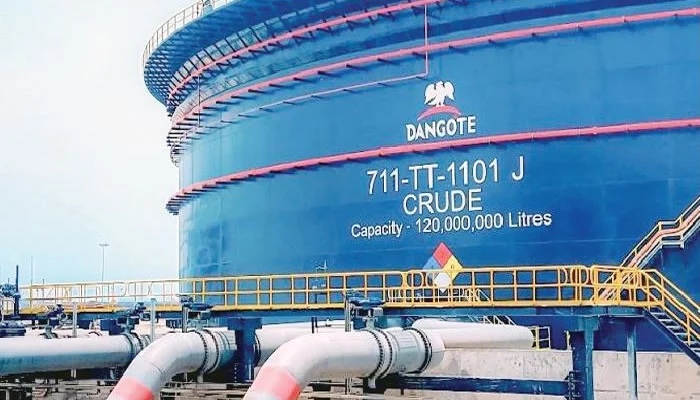
Dangote Petroleum Refinery has dismissed claims that petroleum products exported from its facility are being re-imported into Nigeria through the offshore ship-to-ship (STS) trading hub in Lomé, Togo, describing the allegation as a “web of falsehoods.”
The company made the clarification in a statement issued on Tuesday, June 23, insisting that the claim is not supported by available trade data or commercial logic.
The rebuttal follows reports alleging that refined products exported from the Dangote Refinery were being routed back into Nigeria via offshore trading activities in Lomé.
In its response, the refinery argued that such a practice would be economically irrational and inconsistent with its business model.
According to the company, the estimated logistics cost of transporting products from its facility to Lomé and then back into Nigeria ranges between US$82 and US$90 per metric ton, making any such round-tripping commercially unattractive.
It added that it does not offer export discounts capable of offsetting such costs or creating arbitrage opportunities that would justify re-importation.
“Simply put, there is no evident commercial incentive for a producer to incur additional shipping, storage, financing and handling costs only for the product to return and compete in its largest and closest market,” the company stated.
Dangote Refinery further noted that it has consistently advocated for reduced dependence on imported petroleum products, warning that imports undermine local refining capacity, pressure foreign exchange reserves, and weaken industrial growth.
The allegation of re-importation was linked to comments made by Matthew Tracey-Cook of S&P Global Commodity Insights during a webinar organised by the Major Energy Marketers Association of Nigeria (MEMAN).
Tracey-Cook reportedly claimed that some Dangote-linked coastal volumes were being routed back into Lagos via Lomé, suggesting that a significant portion of imported fuel into Nigeria between March and May originated from Dangote’s exports.
However, the refinery rejected the assertion, stating that it maintains strict records of all product sales, including lifting locations, nominated vessels, counterparties, and destination declarations.
It also stressed that contractual agreements with buyers and its internal compliance procedures prohibit any arrangement that could facilitate such re-importation schemes.
“Any suggestion that the refinery is knowingly facilitating re-importation is inconsistent with the contractual restrictions imposed on buyers and the refinery’s established compliance procedures,” the statement added.
The controversy comes amid rising fuel imports in Nigeria despite increased domestic refining capacity.
Data from the Nigerian Midstream and Downstream Petroleum Regulatory Authority (NMDPRA) showed that average daily imports of Premium Motor Spirit (PMS) rose by 59.5 per cent in May 2026 to 5.9 million litres per day, compared to 3.7 million litres per day in April.
Despite the increase, domestic refineries remained the dominant source of supply, contributing 41.5 million litres per day, representing nearly 88 per cent of total petrol supply during the period.
The figures highlight the growing influence of local refining in Nigeria’s downstream petroleum sector, even as marketers continue to supplement supply through imports to meet domestic demand.