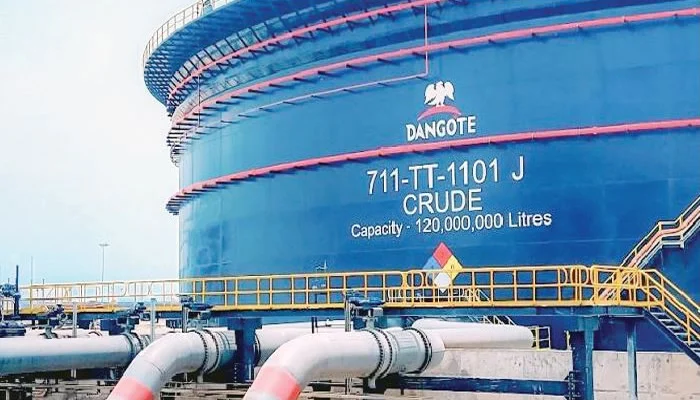
Dangote Petroleum Refinery & Petrochemicals has increased its crude oil processing capacity to 700,000 barrels per day (bpd), surpassing its original nameplate capacity of 650,000 bpd following a successful performance test conducted by its Process Licensors.
The development was disclosed in a statement issued by Dangote Group on Thursday, highlighting the refinery’s growing operational efficiency and expanding role in both domestic and international energy markets.
According to the company, the higher throughput demonstrates the refinery’s engineering strength and ability to optimise operations while processing larger volumes of crude oil than initially designed.
Dangote Industries stated that the successful performance test validates the refinery’s capability to operate above its original design capacity and provides a strong foundation for future expansion plans.
Vice-President of Oil and Gas at Dangote Industries Limited, Devakumar Edwin, said the refinery’s growth is part of a broader strategy to increase total processing capacity to 1.4 million barrels per day within the next 30 months.
He explained that the expansion is expected to strengthen Nigeria’s energy security and significantly reduce the country’s dependence on imported refined petroleum products.
According to Edwin, the company’s long-term vision is to position the refinery among the largest refining complexes in the world while establishing Nigeria as a major global refining and export hub.
“The refinery’s expansion strategy is not limited to meeting domestic fuel demand but is also aimed at increasing Nigeria’s influence in regional and international petroleum markets,” he said.
Owned by Nigerian businessman Aliko Dangote, the refinery commenced fuel production in 2024 and has steadily ramped up output across key petroleum products, including petrol, diesel, aviation fuel and liquefied petroleum gas (LPG).
The facility, originally designed with a processing capacity of 650,000 barrels per day, has become a major supplier of refined petroleum products to Nigeria and several international markets.
Products refined at the Lekki-based facility have been exported to various African countries and European markets, including the United Kingdom, France, Spain, Italy and the Netherlands.
The refinery has also supplied gasoline to the United States and jet fuel to Saudi Arabia, further strengthening its position in global energy supply chains.
Its growing international footprint comes at a time when disruptions in global energy markets have prompted many African nations to seek alternative and reliable sources of refined petroleum products.
In April, S&P Global Commodities reported that Dangote Petroleum Refinery had become the world’s largest exporter of jet fuel, underscoring its rising influence in the international aviation fuel market.
The company recently unveiled plans to more than double the refinery’s capacity to 1.4 million barrels per day by 2028 through the construction of an additional refining facility within the Lekki complex.
If completed as planned, the expansion would place the refinery among the largest refining hubs globally and significantly enhance Nigeria’s role in international energy trade.
Beyond fuel production, the refinery is expected to support several downstream industries through the supply of liquefied petroleum gas, polypropylene and other industrial feedstocks.
Dangote Group also disclosed plans for the future production of Linear Alkylbenzene (LAB), a key raw material widely used in detergent manufacturing, further expanding the facility’s industrial value chain.
Industry analysts believe the refinery’s continued expansion could boost foreign exchange earnings, create jobs, improve energy security and strengthen Nigeria’s position as a leading refining centre in Africa and beyond.