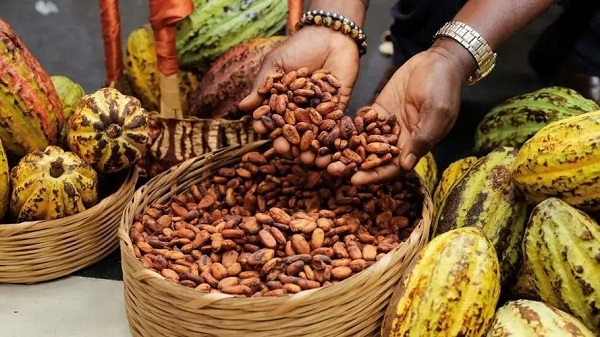
What began as a golden windfall for Nigeria’s cocoa farmers at the start of 2025 has spiralled into a sharp income crisis, as benchmark global prices tumble by nearly 70 per cent from record highs.
Only months ago, cocoa prices surged to almost $11,000 per metric ton, raising hopes of sustained prosperity after years of unstable earnings. That optimism has now faded. Prices have dropped below $4,000 per metric ton — a 2.5-year low that is reverberating across the global cocoa supply chain.
The downturn intensified this week as March ICE New York cocoa futures fell by 5.50 per cent, while London’s ICE contract declined by 3.22 per cent in a single trading session.
For Nigeria — the world’s fifth-largest cocoa producer, with annual output estimated between 280,000 and 300,000 metric tons — the reversal has been swift and severe.
Across West Africa, the impact is already evident. Ghana last week reduced its official farmgate cocoa price by 28.6 per cent to 41,392 cedis, approximately $3,764 per ton, for the remainder of the 2025/26 season. The move was aimed at aligning domestic payments with weakened global benchmarks.
Côte d’Ivoire is widely expected to follow suit. Authorities in Abidjan are reviewing the country’s fixed farmgate price of CFA2,800 per kilogramme.
At the annual meeting of the World Cocoa Foundation in Amsterdam this week, WCF President Chris Vincent acknowledged the scale of the crisis. He noted that senior officials from Ghana and Côte d’Ivoire were absent from the gathering due to pressing domestic concerns.
“The market volatility is placing a strain on farms and institutions in Ghana and Ivory Coast,” Vincent said.
With both countries recovering from earlier supply disruptions and global cocoa stocks replenishing, the supply-demand balance has shifted. The market dynamics that once favoured producers like Nigeria have now reversed.
Research Director of the Cocoa Research Institute of Nigeria, Sam Orisajo, described the slump as a predictable outcome of changing fundamentals.
“When supply exceeds demand, the price of cocoa will drop. If we check it very well, that is exactly what is happening right now — the same principle that drives crude oil prices,” Orisajo said.
He stressed that domestic cocoa prices remain largely influenced by international markets.
“The price fixing is not actually determined in Nigeria. It is based on international markets, and whatever happens in the international market determines the ripple effect that will come on Nigeria,” he explained.
Analysts warn that if the price downturn persists, smallholder farmers — who form the backbone of Nigeria’s cocoa industry — could scale back production or abandon farms altogether, raising concerns about long-term sustainability in one of the country’s most important non-oil export sectors.