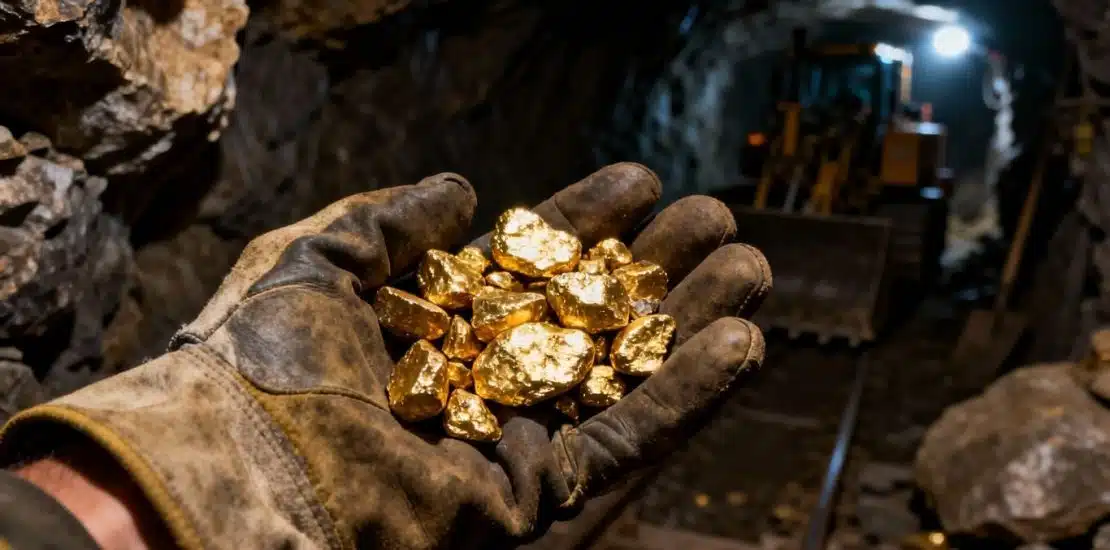
Guinea has introduced a ban on raw gold exports as the West African country intensifies efforts to retain more value from its vast mineral resources and ensure that mining wealth contributes more directly to the domestic economy.
The policy comes as Guinea seeks to transform a mining sector that has historically been dominated by exports of unprocessed commodities, despite the country’s enormous reserves of gold, bauxite, diamonds and high-grade iron ore.
Guinea is home to the world’s largest untapped reserve of high-grade iron ore and is one of West Africa’s leading gold producers.
However, the country has struggled to translate its mineral wealth into broad-based prosperity, with much of its resources traditionally exported in raw form and limited processing taking place domestically.
The government is now seeking to change that approach as the transformative Simandou iron ore project moves into production after years of delays.
Simandou, regarded as the world’s largest untapped high-grade iron ore deposit, began production in November, raising expectations of a major increase in Guinea’s mining revenues and economic activity.
The government’s push for greater local processing extends beyond iron ore.
At the end of June, President Mamady Doumbouya, who came to power following a military coup in 2021, banned the export of raw gold.
The new policy coincides with the construction of a gold refinery in Conakry with a refining capacity of 250 tonnes per year, significantly above Guinea’s current production levels.
Guinea exported about 22 tonnes of gold in the first quarter of 2025 alone.
The government’s policy is aimed at ensuring that more of the value generated from the country’s gold resources is retained domestically.
Guinea has traditionally exported unprocessed gold, which generally attracts a lower value than refined gold because of impurities and the additional processing required abroad.
Under the new rules, companies that fail to comply could face the revocation of their mining licences and termination of their mining contracts.
The government’s willingness to enforce mining policies has already been demonstrated in other areas of the sector.
Last year, authorities took over Guinea Alumina Corporation, the local bauxite subsidiary of Emirates Global Aluminium, following allegations that the company had failed to fulfil its commitment to construct an alumina refinery.
In March, reports indicated that Guinea was close to reaching an agreement with EGA, including compensation, in an effort to avoid arbitration.
The government is also facing a separate arbitration case involving Emirati company Falcon Energy Materials.
The company lodged a request for arbitration under the UAE-Guinea bilateral investment treaty with the International Centre for Settlement of Investment Disputes, claiming $100 million in damages over what it described as the illegal expropriation of the Lola Graphite Project and other alleged breaches of the treaty.
Guinea is not the only African country pursuing tighter controls on the export of unprocessed minerals.
Ghana has announced plans to ban unprocessed gold exports by 2030, while Uganda and Tanzania have already introduced restrictions on the export of unprocessed minerals.
The Democratic Republic of Congo also recently banned exports of copper and cobalt concentrates as it steps up efforts to encourage domestic processing.
Other African governments have argued that reforms to their mining sectors have increased state revenues.
Mali’s finance minister, for instance, said the country had recovered $1.2 billion in tax arrears from international companies following the tightening of its mining code in 2023.
Guinea’s own mining strategy includes plans to channel at least 0.5 per cent of mining companies’ profits into local development funds.
The government also intends to establish a sovereign wealth fund to finance schools, hospitals, agricultural projects and paved roads.
Guinea is further targeting the construction of five or six additional alumina processing plants by 2030 to encourage mining companies to refine more of their output locally.
According to Tiffany Wognaih, managing consultant in JS Held’s Strategy & Risk Advisory unit, the gold export ban reinforces the government’s broader push for local content and mineral transformation since Doumbouya came to power.
The government is betting that renewed interest in Guinea’s mining industry, particularly following progress at Simandou, will encourage mining companies to comply with its new policies.
S&P Global raised its outlook for Guinea from “stable” to “positive” in March, citing the potential strength of the mining sector.
“The mining sector, accounting for about 20% of the economy and 90% of exports, will continue to support strong economic growth,” S&P Global said.
However, the government’s approach could also create concerns among international mining companies.
Oumar Totiya Barry, executive director of the Guinean Observatory of Mines and Metals, said mining companies have clauses in their agreements with the government that provide them with export freedoms.
“Mining companies could potentially lean on this clause to fight against this presidential declaration,” Barry said.
Mining companies are also likely to seek clarity on how quickly they must comply with the new requirement to refine gold locally, particularly following the completion of the refinery in Conakry.
Implementation could present additional challenges.
Wognaih said the success of the policy would depend on whether the supporting ecosystem could be established quickly enough.
This includes refining capacity, customs procedures, certification systems and export processes.
The government has introduced a 30-day consultation period and a 90-day transition period for implementation of the new law.
However, frequent policy changes and limited notice to foreign operators have historically created uncertainty for companies operating in Guinea.
“There is likely to be frustration with some policy decisions, particularly where implementation timelines appear ambitious or mechanisms remain unclear,” Wognaih said.
“Investors will be watching closely to see whether local processing ambitions can be balanced with the need to maintain an attractive investment environment,” she added.
Global mining companies already face operational challenges in Guinea, including an electricity supply system that remains weak and unreliable.
There are concerns that the country’s new refineries could also face difficulties operating efficiently if infrastructure constraints are not addressed.
The new gold export restrictions will also affect artisanal miners.
Artisanal miners exported about 50 tonnes of gold to neighbouring countries in 2025, and transporting raw gold to the new refinery could prove costly and time-consuming for small-scale producers.
The government could therefore face difficulties preventing some artisanal miners from circumventing the new rules through smuggling routes.
Despite the enforcement challenges, the policy is likely to receive significant domestic support.
Guinean observers say increased refining capacity and the shift towards local mineral beneficiation are broadly welcomed by citizens who have long argued that the country has failed to benefit sufficiently from its enormous natural resource wealth.
The challenge for Guinea will now be to turn its mineral-processing ambitions into a sustainable system that increases government revenues, creates jobs and supports local businesses without discouraging the international investment needed to develop its mining industry.