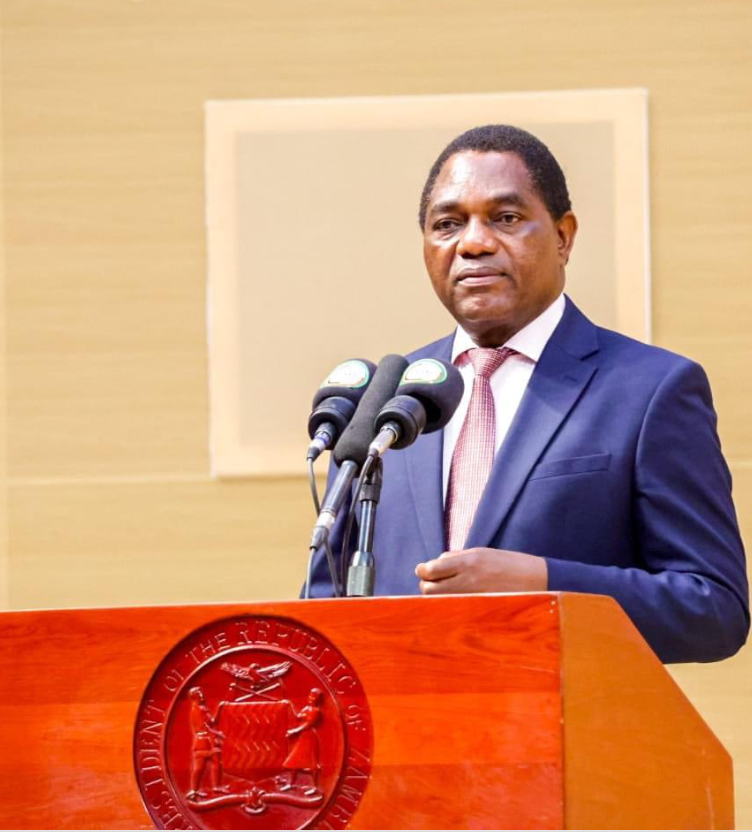
Zambian President Hakainde Hichilema has secured a second five-year term after winning the country’s presidential election with about 60% of the valid votes.
The election result, announced on Tuesday, August 18, 2026, gave Hichilema a clear victory over his main challenger, opposition leader Brian Mundubile, who received about 38% of the vote. The result means Hichilema will continue leading the southern African nation after first coming to power in 2021. However, his victory comes at a time when many Zambians are demanding that the country’s improving economic situation leads to better conditions for ordinary people.
The election was not without controversy. Vote counting was temporarily suspended after violence and disruptions at some polling stations. There were also reports of attacks on election officials and allegations involving the theft of marked ballot papers. Opposition members were arrested during a law enforcement operation that included gunfire, while authorities accused those detained of planning an armed insurrection. Mundubile denied the allegations.
Although election observers said the process was largely peaceful overall, concerns were raised about aspects of the campaign environment, including legal uncertainties and unequal conditions for political competitors. These issues have added to the debate surrounding the election and could continue to shape Zambia’s political climate during Hichilema’s second term.
Economic recovery remains a major issue
One of the biggest questions facing Hichilema is whether his government can make economic progress more visible in the daily lives of Zambians.
His administration has been credited with helping to stabilise the economy after Zambia faced a major debt crisis. The government restructured the country’s debt and worked to restore investor confidence. Hichilema has also promoted investment in the mining sector and plans to increase copper production significantly.
Zambia is one of the world’s major copper producers. The metal has become increasingly important because it is used in electric vehicles, renewable energy systems and many modern technologies. As global demand grows, Zambia is attracting interest from major international investors and governments seeking access to critical minerals.
However, economic indicators do not always reflect how people experience life. Many Zambians continue to struggle with the high cost of food and other basic goods. Energy shortages and unemployment have also remained serious concerns.
These challenges gave the opposition an opportunity to argue that economic recovery has not been shared widely enough. Mundubile’s stronger-than-expected performance showed that frustration remains among sections of the population.
Hichilema promises more jobs and growth
As he begins his second term, Hichilema has said he wants to build on the progress made during his first five years in office.
His plans include expanding the economy, creating more jobs and increasing opportunities for households. He has also made copper production a major part of his economic strategy, believing that the mining sector can support long-term national growth.
Reuters reported that Hichilema wants to turn Zambia’s recovery from its debt crisis into broader economic expansion. His government will therefore face pressure to ensure that growth creates employment and improves incomes rather than benefiting only major companies and investors.
The president’s supporters believe his experience as an economist and businessman will help him achieve these goals. They argue that economic reforms and increased investment have put Zambia on a stronger path.
Critics, however, are likely to continue asking why many families are still struggling despite the government’s claims of economic progress.
A politically important second term
The new term will also test Hichilema’s ability to manage political tensions.
The election campaign highlighted deep divisions between the government and opposition groups. Allegations of repression, concerns about arrests and disagreements over political freedoms have created an atmosphere of mistrust.
For Hichilema, winning the election may therefore be only the first challenge. He will now have to govern a country where millions of people did not vote for him.
In his response to the result, he promised to work for all Zambians, including those who supported other candidates. That promise will be closely watched as his government begins its second term.
Zambia remains one of Africa’s more established multiparty democracies, and the peaceful transfer of power in 2021 was widely seen as an important democratic achievement. The events surrounding the 2026 election, however, have shown that political tensions can still threaten confidence in the process.
What happens next?
Hichilema now has five more years to prove that his economic policies can improve the lives of ordinary citizens.
His government will need to deal with the cost of living, unemployment, electricity problems and demands for greater economic inclusion. At the same time, it will have to manage international competition for Zambia’s valuable copper resources.
The president’s victory gives him another opportunity to pursue his economic agenda. However, the strength of the opposition vote sends a clear message that many Zambians want to see practical results.
For the new administration, economic stability alone may not be enough. The real test will be whether families can feel the benefits through more jobs, improved incomes and a lower cost of living.