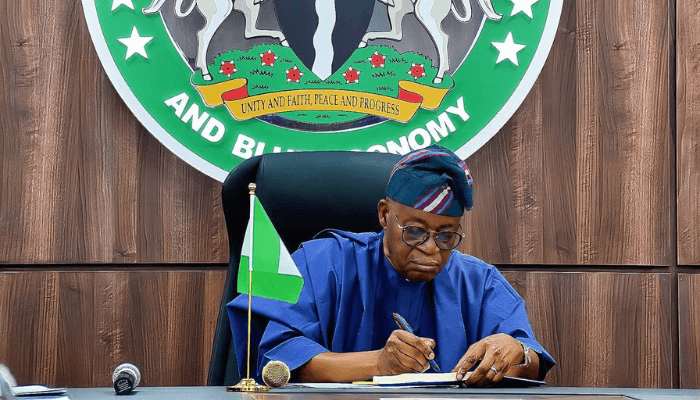
The United States has lifted the 12-year Condition of Entry imposed on Nigerian vessels arriving at US ports, a development expected to improve Nigeria’s maritime competitiveness, vessel turnaround time and schedule reliability.
The announcement was made by the Minister of Marine and Blue Economy, Adegboyega Oyetola, according to a statement published on NIMASA’s X page on Tuesday.
The Condition of Entry was imposed by the US Coast Guard in June 2014 following concerns over Nigeria’s compliance with international maritime security standards at some of its port facilities.
Its removal is expected to reduce some of the additional security-related requirements and costs previously imposed on vessels operating between Nigeria and the United States.
Oyetola described the development as a major milestone for Nigeria’s maritime sector, following sustained efforts by the Federal Ministry of Marine and Blue Economy, NIMASA and other stakeholders to strengthen maritime security and ensure compliance with the International Ship and Port Facility Security Code.
The minister also commended NIMASA Director-General, Dayo Mobereola, and other stakeholders for their contribution to securing the removal of the restriction.
The US Coast Guard imposed the Conditions of Entry in June 2014 after determining that Nigerian ports, except for specified facilities, did not maintain effective anti-terrorism measures.
In a notice published in the Federal Register on June 12, 2014, the Coast Guard identified deficiencies relating to Nigeria’s legal regime, designated authority oversight, access control and cargo control.
The restrictions took effect on June 26, 2014, and applied to vessels that had visited a non-exempt Nigerian port within their previous five port calls.
Affected vessels were required to implement security measures equivalent to Security Level 2 while in Nigerian ports and ensure that every access point to the vessel was guarded.
They were also required to attempt to execute a Declaration of Security, record security actions and report them to the appropriate US Coast Guard Captain of the Port before arriving in US waters.
The Coast Guard said Nigeria had been notified of the determination in March 2013 and given recommendations for improving its anti-terrorism measures, as well as 90 days to respond. However, it said it could not confirm that the identified deficiencies had been corrected at the time.
The 2014 notice exempted specified Nigerian port facilities, including terminals in Apapa, Bonny, Escravos, Forcados, Onne and Tin Can Island, from the Conditions of Entry.
The removal of the restriction comes as activity across Nigeria’s ports continues to expand.
Nigeria’s cargo throughput rose to 32.38 million metric tonnes in the first quarter of 2026, representing an 11.6% year-on-year increase, driven by stronger port activity.
Ocean-going vessel Gross Registered Tonnage increased by 19.5% to 46.75 million, while outward cargo volumes climbed by 23.7% to 14.13 million tonnes.
Outward laden containers surged by 67.6% to 102,803 TEUs, while vehicle traffic increased by 67% to 58,870 units.
In 2025, total cargo throughput rose by 24.8% to 129.3 million metric tonnes, while container traffic increased by 25.7% to more than 2.1 million TEUs.
The Managing Director of the Nigerian Ports Authority, Abubakar Dantsoho, attributed the first-quarter 2026 performance to improved cargo efficiency, rising international shipping confidence and the deployment of larger vessels linked to operations at Lekki Deep Sea Port.
Nigeria’s port development pipeline is also expanding through private and public-sector investments aimed at improving capacity and efficiency.
MSC Group signed a 45-year concession with Nigerdock in March to develop a container terminal at Snake Island Port in Lagos. The project includes a 910-metre quay, deep-sea vessel capacity and a 30-hectare container yard with expansion options.
A £746 million, approximately $1 billion, UK-backed financing package will also support upgrades at Apapa Port and Tin Can Island Port.
The planned improvements include automation, reduced cargo dwell time, expanded quays and modern cargo-handling infrastructure.
The lifting of the US restriction, alongside ongoing investments in port infrastructure, is expected to strengthen Nigeria’s position in global shipping, reduce vessel-related delays and costs, and improve the country’s attractiveness to international shipping operators.