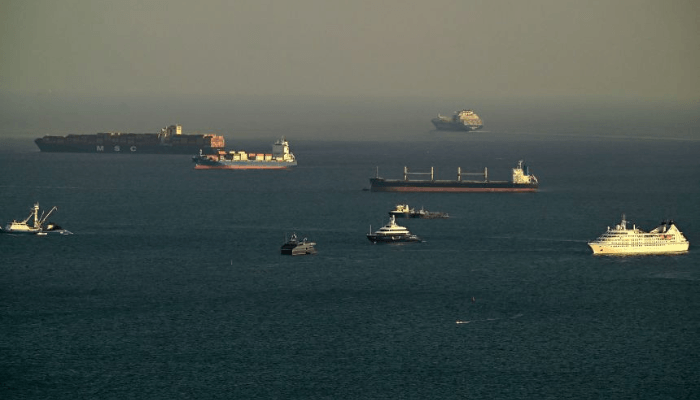
Commercial shipping through the Strait of Hormuz has dropped to its lowest level in two months as escalating military tensions involving the United States, Iran and Yemen’s Houthi rebels continue to disrupt one of the world’s most important energy routes.
Preliminary vessel-tracking data from Kpler, cited by Reuters, showed that only three vessels passed through the Strait of Hormuz on each of July 22, 23 and 24. The waterway normally handles about one-fifth of global oil trade, making it a critical corridor for international energy supplies.
On Friday, a very large crude carrier (VLCC), Romania Prosperity, carrying Murban crude, was seen off Fujairah outside the strait, although its final destination was not disclosed. Two empty bulk carriers also exited the strait into the Gulf.
A day earlier, the New Giant, a VLCC carrying about two million barrels of Iraqi Basrah crude, sailed through the Strait of Hormuz. The vessel is expected to arrive at Rizhao Port in China by mid-August. Two additional vessels, including the empty VLCC Noble, also entered the Gulf through the strait.
The disruption comes as the United States completed its 13th consecutive night of military strikes on Iran, raising concerns that the conflict could spread further and threaten energy infrastructure across the Gulf.
Despite repeated Houthi attacks, shipping through the Bab el-Mandeb Strait has remained relatively stable.
According to Kpler, 32 commodity vessels passed through the Bab el-Mandeb on July 23, up from 26 the previous day. Fourteen ships entered the Red Sea, while 18 exited into the Gulf of Aden, including nine crude oil tankers and two Chinese supertankers heading to China.
However, some shipping companies have started changing their traditional routes to avoid security risks.
The tanker Torm Innovation, carrying about 500,000 barrels of naphtha bound for Asia, reportedly diverted towards the Suez Canal instead of using the Bab el-Mandeb route.
Industry sources said rerouting cargo through the Suez Canal could make voyages to Asia nearly three times longer, increasing freight costs and delaying deliveries.
Saudi Aramco has also adjusted its export strategy by offering additional crude cargoes from Sidi Kerir on Egypt’s Mediterranean coast as an alternative to its Red Sea export terminals.
The impact of the security threats is already affecting Asian energy markets.
Reports indicated that an India-bound Saudi crude tanker turned back after Houthi threats to intercept vessels passing through the Bab el-Mandeb. Another tanker carrying crude to China also reversed course, highlighting growing concerns over the safety of one of the world’s busiest shipping lanes.
Matthew Wright, principal freight analyst at Kpler, said the vessel diversions show that shipowners are taking the security risks seriously.
He warned that if more operators begin avoiding the route, the impact could extend far beyond a few delayed cargoes and significantly disrupt global oil trade.
Oil prices have reacted strongly to the rising tensions.
As of Sunday, Brent crude traded at $96.78 per barrel, moving closer to the $100 mark as fears of supply disruptions intensified.
ING Group said Houthi attacks on Saudi vessels, combined with renewed US threats against Iran, have significantly increased the risk to energy infrastructure across the region.
The bank said that with no clear signs of de-escalation, oil prices are likely to remain under upward pressure and could climb further if the conflict worsens.
ING also warned that supply risks are now at their highest level since the conflict began, noting that oil flows through the Strait of Hormuz have slowed sharply.
Meanwhile, Saudi crude exports from Yanbu, which averaged about 4.6 million barrels per day in June, are becoming increasingly vulnerable to attacks in the Red Sea.
Adding to the tensions, US President Donald Trump warned that Washington would hold Iran responsible for any future Houthi attacks on commercial vessels and threatened major military retaliation if further incidents occur.
Iran responded by warning that any threat to its own security could put energy infrastructure across the region at risk.