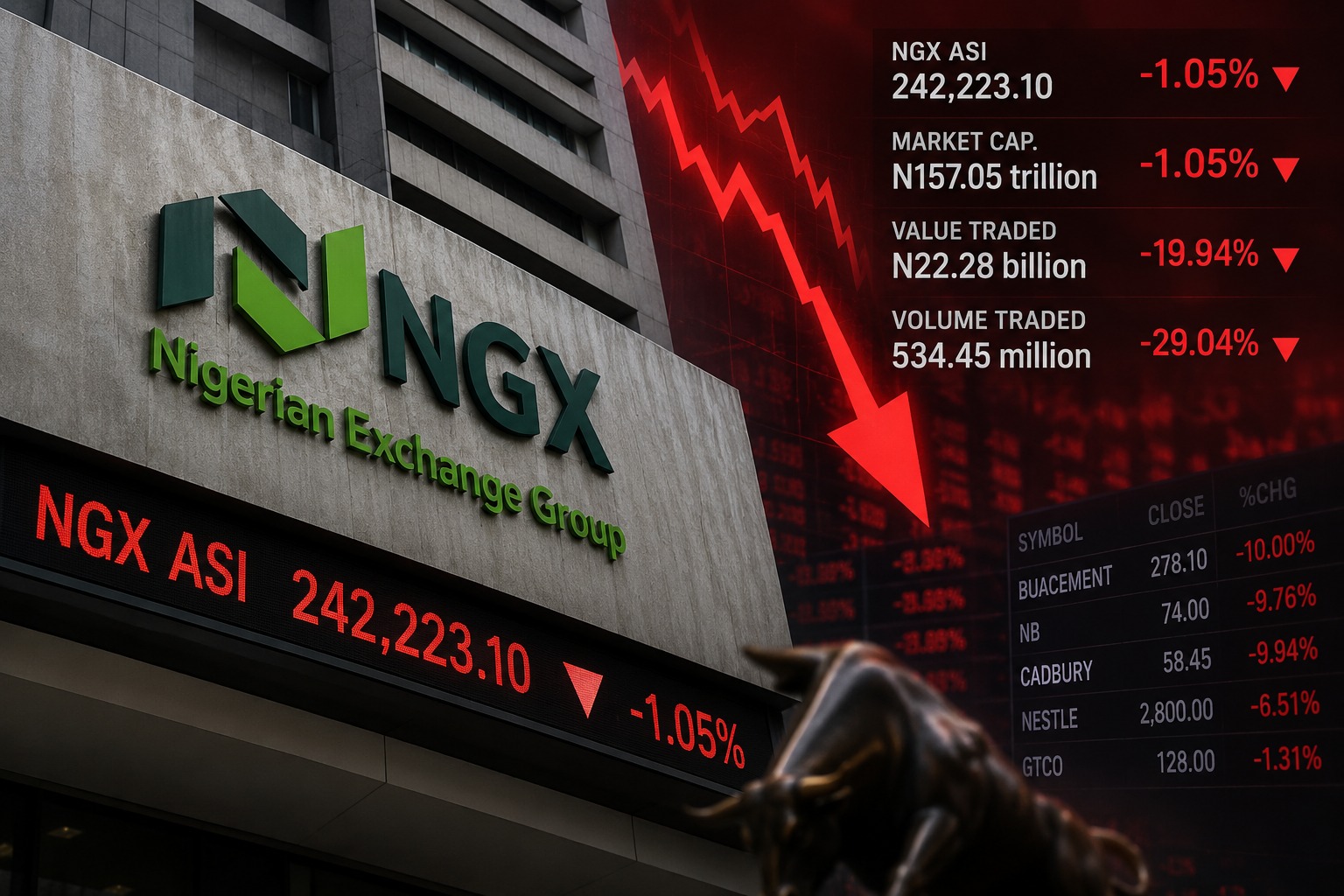
The Nigerian equities market extended its bearish run for a third consecutive trading session on Wednesday, September 9, as widespread losses across major sectors pushed the benchmark index down by 1.05 per cent and wiped approximately N1.67 trillion from investors’ wealth.
The Nigerian Exchange All-Share Index, NGX ASI, declined by 1.05 per cent to 242,223.10 points, while market capitalisation fell at the same rate to N157.05 trillion. The decline moderated the market’s year-to-date return to 55.66 per cent, from 57.31 per cent in the previous session.
Based on the report’s market-capitalisation figures, the day’s decline represents roughly N1.67 trillion in lost market value.
Selling pressure was particularly evident in BUACEMENT, Nigerian Breweries and Cadbury Nigeria, while gains in Champion Breweries, VFD Group and UPDC were insufficient to reverse the broader market decline.
BUACEMENT, Nigerian Breweries Weigh on Market
BUACEMENT fell by the maximum 10 per cent to close at N278.10, while Nigerian Breweries declined 9.76 per cent to N74.00. Cadbury Nigeria shed 9.94 per cent to finish at N58.45.
Other significant losers included JAPAULGOLD, FTN Cocoa, NSL Tech, Omatek and Zichis, which each lost 10 per cent during the session.
At the opposite end of the market, Champion Breweries led the gainers, rising 9.90 per cent to N11.10.
VFD Group followed with a 9.52 per cent increase to N11.50, while UPDC gained 5.88 per cent to N3.60. Ikeja Hotel advanced 4.58 per cent, while Cutix appreciated by 3.06 per cent.
Sterling Financial Holdings also gained 2.67 per cent, while Zenith Bank advanced 1.64 per cent to N124.00.
The inability of those gains to offset losses in heavily weighted counters left the broader market firmly in negative territory.
All Major Sectors Close Lower
Selling pressure was broad-based, with all five sector indices tracked in the report closing in negative territory.
The Industrial Goods Index recorded the steepest decline, falling 3.09 per cent, followed closely by the Insurance Index, which lost 3.07 per cent.
Consumer Goods declined 2.09 per cent, Banking fell 0.53 per cent, while Oil and Gas recorded a relatively marginal 0.20 per cent decline.
Despite the day’s losses, performance since the beginning of the year remains sharply divergent across sectors. Oil and Gas retains a year-to-date gain of 115.78 per cent, while Industrial Goods is up 76.15 per cent and Banking has gained 64.51 per cent. Insurance, by contrast, remains down 12.29 per cent year-to-date.
The across-the-board decline reinforces the breadth of the latest correction after the strong gains accumulated by Nigerian equities earlier in the year.
Trading Activity Falls as Investors Turn Cautious
Market activity also weakened significantly.
A total of 534.45 million shares were traded during the session, representing a 29.04 per cent decline from the previous trading day.
The value of transactions dropped by 19.94 per cent to N22.28 billion, while the number of deals fell 13.15 per cent to 46,943.
Sterling Financial Holdings emerged as the most actively traded stock by volume, with 78.11 million shares changing hands.
MBenefIT followed with 75.54 million shares, while Access Holdings recorded 25.11 million shares. Zenith Bank accounted for 22.10 million shares, with Chams recording 19.56 million shares.
By transaction value, Nestlé Nigeria led the market with N3.20 billion, followed by Zenith Bank, Seplat Energy, GTCO and Aradel.
Market Breadth Shows Heavy Selling Pressure
The depth of the selloff was reflected in market breadth.
Only 11 stocks advanced, compared with 49 decliners, producing a weak market breadth of 0.19x.
The imbalance suggests that the decline was not confined to a handful of large-cap stocks but spread across a significant portion of the market.
Despite the correction, the NGX ASI remains up 55.66 per cent since the beginning of 2026, indicating that the market is still holding substantial gains accumulated earlier in the year.
Some individual stocks have delivered considerably larger returns.
SCOA remained the strongest year-to-date performer in the report with a gain of 365.49 per cent, followed by Union Dicon Salt at 244.20 per cent, Berger Paints at 207.50 per cent and First HoldCo at 183.92 per cent.
Airtel Africa was up 177.53 per cent year-to-date, while Aradel and Seplat Energy had gained 134.33 per cent and 133.30 per cent respectively.
NASD Market Bucks Negative Trend
While listed equities on the NGX remained under pressure, the NASD Over-the-Counter market closed higher.
The NASD Security Index advanced 0.84 per cent to 4,533.41 points, while market capitalisation increased by the same margin to approximately N2.72 trillion.
Its year-to-date return improved to 27.93 per cent.
Trading activity also strengthened sharply, with volume surging 364.59 per cent to 998,890 units and transaction value increasing 84.04 per cent to N61.18 million. A total of 34 transactions were completed, representing a 78.95 per cent increase from the preceding session.
SDCSCSPLC led gainers with a 4.32 per cent increase, while SDNASDPLC was the biggest loser after declining 11.06 per cent.
Naira Weakens to N1,329.21/$ at NAFEM
Pressure was also recorded in the foreign exchange market.
The naira depreciated by 0.65 per cent at the Nigerian Foreign Exchange Market, NAFEM, closing at N1,329.21 to the US dollar, compared with N1,320.56 previously.
The report also showed NAFEX at N1,373.87/$, compared with N1,378.25/$ previously.
Coronation Research specifically reported that NAFEM depreciated by 0.65 per cent to N1,329.21/US$1.
The currency movement adds another variable for equity investors because exchange-rate changes can influence foreign portfolio flows, imported input costs and the earnings outlook of companies with significant foreign-currency exposure.
Oil Climbs Above $100 Amid Middle East Tensions
The report also highlighted a sharp rise in international crude oil prices amid escalating geopolitical tensions.
Brent crude was quoted at $101.21 per barrel, up 3.05 per cent, while West Texas Intermediate rose 3.17 per cent to $96.34 per barrel. Bonny Light was reported at $102.54 per barrel, although its latest available price was dated September 4.
Coronation Research attributed the increase to escalating US-Iran attacks affecting shipping and energy infrastructure, which heightened concerns about further supply disruptions.
The report noted that shipping volumes through the Strait of Hormuz remained below pre-war levels, while attacks involving oil tankers and merchant vessels had increased risks to global energy flows.
For Nigeria, higher crude prices can potentially improve oil-export receipts and government revenues, although the ultimate benefit depends on production volumes, export performance and other fiscal factors.
Global Markets Also Under Pressure
The report showed weakness across several major international equity benchmarks available at the time of publication.
The Dow Jones Industrial Average declined 1.08 per cent, while the Nasdaq Composite fell 0.78 per cent. Japan’s Nikkei 225 slipped 0.12 per cent and South Africa’s JSE All-Share Index declined 0.39 per cent.
Coronation Research also noted that the US Treasury planned to buy back as much as $6 billion of longer-dated government debt, three times its normal buyback size, in an attempt to improve liquidity in parts of the Treasury market.
Despite the planned intervention, longer-term yields continued to rise amid investor concerns over government debt, persistent inflation risks and elevated energy prices.
For the Nigerian equities market, however, the immediate picture remains one of continued profit-taking and broad selling pressure.
After three consecutive sessions of losses and a market breadth showing almost five decliners for every advancing stock, investors will be watching whether bargain hunting returns to heavily discounted counters or whether the correction extends further.