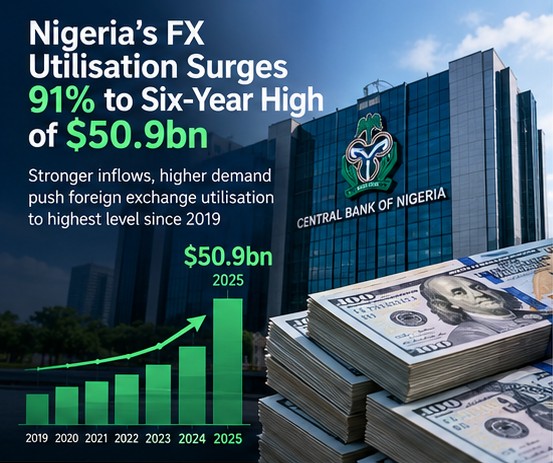
Nigeria’s foreign exchange utilisation climbed to $50.93 billion in 2025, its highest annual level in six years, as businesses, importers and other economic agents significantly increased demand for foreign currency.
The figure represents a 91.1 per cent increase from the $26.65 billion recorded in 2024 and marks the strongest annual FX utilisation since 2019, according to data contained in the Central Bank of Nigeria’s 2025 Statistical Bulletin.
The sharp increase provides another indication of the scale of activity taking place in Nigeria’s foreign exchange market following years of shortages, exchange-rate adjustments and reforms intended to improve price discovery and liquidity.
Quarterly data showed that FX utilisation remained elevated throughout 2025.
Nigeria recorded $12.71 billion in the first quarter, rising to $13.13 billion in the second quarter. Utilisation moderated to $12.01 billion in the third quarter before recovering to $13.08 billion during the final three months of the year.
FX Inflows Rise to $109.86bn
The increased demand was accompanied by stronger foreign currency inflows.
Aggregate FX inflows rose by 13.81 per cent to $109.86 billion in 2025, compared with $96.53 billion in the preceding year.
Outflows also increased, climbing 27.83 per cent from $38.37 billion to $49.05 billion.
Despite the higher outflows, Nigeria finished the year with a net FX inflow of approximately $60.81 billion, compared with $58.16 billion in 2024.
The figures are important because the availability and cost of foreign exchange remain critical considerations for Nigerian businesses, particularly manufacturers and other companies dependent on imported machinery, raw materials and intermediate goods.
Improved liquidity can make it easier for businesses to plan foreign-currency obligations, although the nearly twofold increase in utilisation also demonstrates how significant underlying dollar demand remains.
Reserves Cross $54bn
Nigeria’s external position has continued to strengthen in 2026, with foreign exchange reserves crossing the $54 billion mark in early September.
Activity in the official FX market, however, continues to fluctuate.
Recent market data showed the naira trading around N1,329 to the dollar after weakening during Wednesday’s session, illustrating that stronger reserves and inflows have not eliminated day-to-day currency volatility.
The bigger test will be whether Nigeria can sustain sufficient autonomous FX inflows — particularly from exports, remittances and foreign investment — to meet increased demand without creating renewed pressure on the currency.