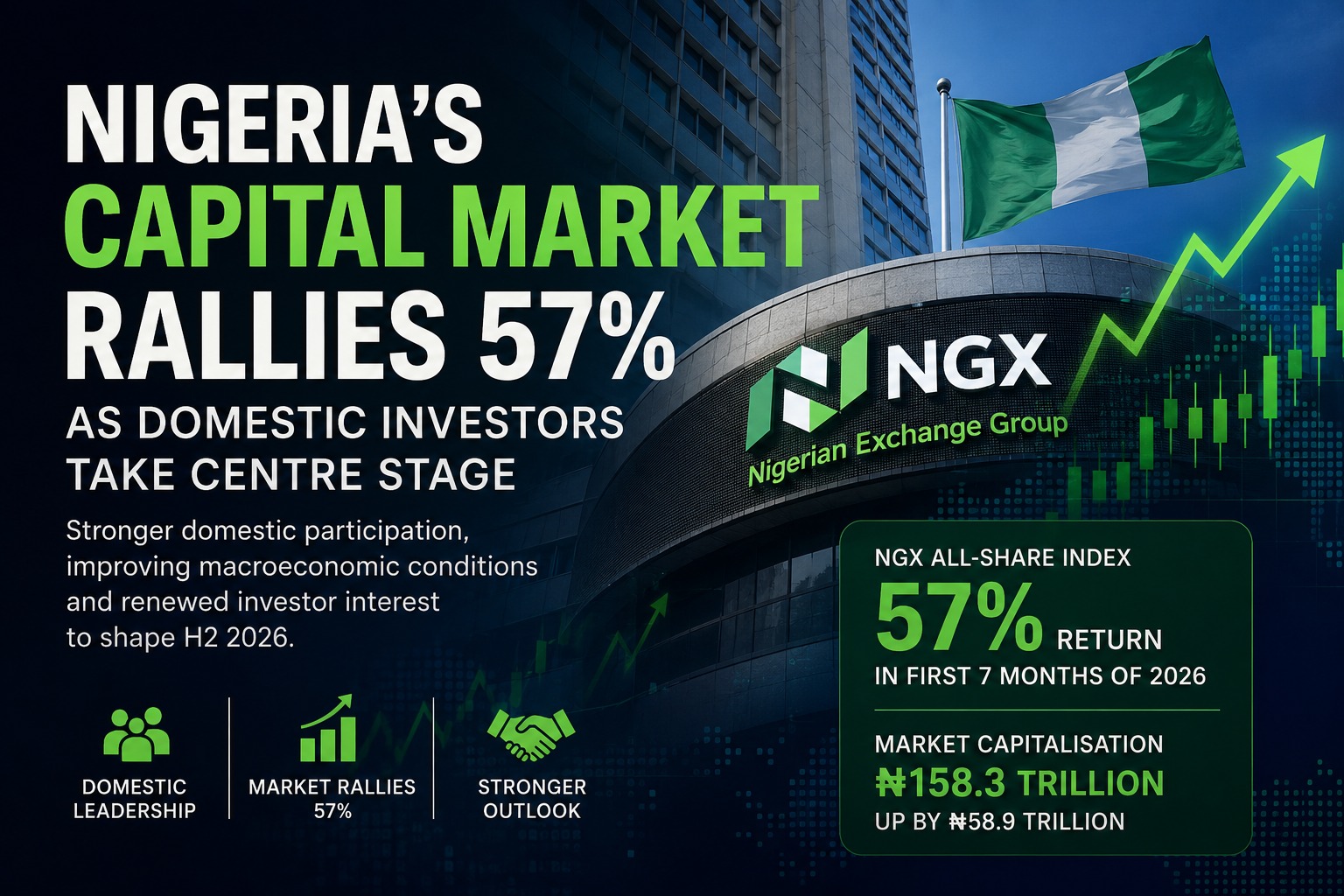
Nigeria’s capital market delivered a strong performance in the first seven months of 2026, with the NGX All-Share Index recording a 57 per cent return as domestic investors increasingly emerged as the major force supporting market activity.
The development was highlighted at the 2026 Coronation Media Parley, organised in collaboration with the Capital Market Correspondents Association of Nigeria (CAMCAN), where market leaders, researchers and financial journalists examined the outlook for the second half of the year.

The parley, themed “Positioning for the Second Half: Market Outlook, Capital Flows and Investment Opportunities,” focused on the factors behind the market’s strong first-half performance, capital flows and opportunities available to investors.
Total market capitalisation increased by ₦58.9 trillion during the first seven months of the year, reaching ₦158.3 trillion.
Speaking at the session, Aigbovbioise Aig-Imoukhuede, Managing Director of Coronation Asset Management, said the market’s performance represented more than a temporary rally, pointing to deeper structural changes in Nigeria’s investment landscape.
“The rally we have witnessed is not merely a market event. It reflects a stronger domestic capital base, improving macroeconomic stability and a growing opportunity for long-term investors who position thoughtfully for the second half of the year,” Aig-Imoukhuede said.
He noted that the composition of market participation had changed significantly, with domestic institutional and retail investors providing an increasingly important source of capital.
According to data presented at the parley, foreign investors accounted for 12.1 per cent of NGX transaction value as of June 2026, compared with 27.1 per cent a year earlier.
At the same time, domestic participation expanded considerably, with pension funds and other institutional investors playing a larger role following changes to investment thresholds.

Aig-Imoukhuede said the shift should not be interpreted as Nigeria turning away from international capital.
Rather, he described it as evidence that the Nigerian market is developing a stronger domestic foundation capable of supporting sustainable growth.
“Markets become resilient when they are supported by savings rather than speculation,” he said.
The strong headline performance of the equities market, however, masks significant differences among sectors and individual companies.
Gbemisola Adelokiki, Head of Equities Research at Coronation Research, highlighted the need for greater selectivity as investors assess opportunities during the remainder of 2026.
Her analysis pointed to the importance of earnings quality, valuations, liquidity, corporate governance and the ability of individual companies to benefit from the broader economic recovery.
With several large-cap stocks already experiencing significant re-rating, investors may have to become more discerning rather than assume that the wider market’s performance will automatically translate into gains across all equities.
Meanwhile, improving foreign-exchange liquidity, a stronger reserve position and greater currency stability could create a more favourable environment for renewed international investment.
The ongoing banking recapitalisation cycle, corporate earnings and broader economic reforms could also strengthen Nigeria’s investment case.
A possible review of Nigeria’s classification by global index providers could provide another catalyst for foreign participation. Although no outcome is guaranteed, a change in classification could improve Nigeria’s visibility among global investors and potentially attract both passive and active capital flows.
Aig-Imoukhuede urged investors to consider opportunities before they become fully recognised by the wider market.
“The best opportunities are often identified before consensus recognises them. Those who wait for certainty will almost certainly pay a higher price than those willing to position for probability,” he said.
For the second half of 2026, the market is expected to reward investors who prioritise quality and selectivity.
With monetary policy expected to remain broadly stable, opportunities could emerge in quality credit, infrastructure debt and other longer-term fixed-income instruments.
Infrastructure financing is also expected to remain an important long-term opportunity, given Nigeria’s substantial funding requirements in sectors such as energy and transportation.
Closing his address, Aig-Imoukhuede described the Nigerian capital market as being at an important inflection point.
“The first half of 2026 demonstrated the strength of Nigerian capital. The second half will test the confidence of global capital. I believe Nigeria is better positioned today than at any point in recent years to attract both,” he said.
He added that the objective should extend beyond short-term market returns.
“The opportunity before us is not simply to deliver market returns. It is to build a capital market that is deeper, more trusted, more liquid and more globally relevant.”
The outlook presented at the Coronation Media Parley suggests that the next phase of Nigeria’s capital-market growth could depend increasingly on the strength of domestic savings, quality investment opportunities and the country’s ability to attract and retain international capital.