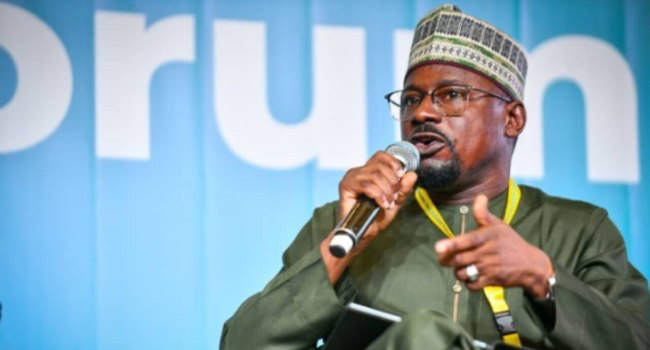
The Managing Director and Chief Executive Officer of the Rural Electrification Agency (REA), Dr. Abba Aliyu, has described distributed renewable energy as Nigeria’s fastest route to sustainable economic growth, stressing that reliable electricity remains critical to the country’s industrial competitiveness.
Speaking at the Lagos Chamber of Commerce and Industry (LCCI) Renewable Energy Outlook Conference in Lagos, Dr. Aliyu said Nigeria must embrace a diversified and coordinated energy strategy that combines grid and off-grid solutions to meet growing electricity demand.
Delivering a keynote address titled “Scaling Mini-Grids and Solar Infrastructure for Industrial Production,” he noted that the country’s economic future depends on its ability to develop affordable, reliable and scalable power systems.
“Scaling mini-grids and solar infrastructure for industrial production is not about choosing between the grid and off-grid systems,” Aliyu said.
“It is about designing a smarter power system that uses every viable tool available. Nigeria needs the national grid. Nigeria needs gas. Nigeria needs hydropower. Nigeria needs solar. Nigeria needs storage. Nigeria needs embedded generation. Nigeria needs mini-grids. Nigeria needs private capital. Nigeria needs local manufacturing. Nigeria needs data. And Nigeria needs coordination.”
According to him, the future renewable energy market will differ significantly from traditional power systems, making it necessary for regulations to remain forward-looking and supportive of innovation while protecting consumers.
Aliyu commended recent regulatory reforms introduced by the Nigerian Electricity Regulatory Commission, noting that measures such as net billing frameworks and the expansion of interconnected mini-grid capacity from one megawatt to five megawatts would accelerate industrial-scale deployment of renewable energy solutions.
He explained that the expanded capacity framework creates opportunities for factories, residential estates, universities, market clusters and data centres to connect to more flexible and reliable power networks.
The REA boss also urged private sector players to take a more active role in developing energy solutions across the country.
“A mini-grid that powers homes changes lives. But a mini-grid that powers homes, a rice mill, a cold room, a welding cluster, a clinic, a digital services hub, and a market changes an economy,” he said.
Aliyu called on financial institutions to move beyond conventional equipment financing and provide innovative funding mechanisms, including project preparation facilities, local currency financing and carbon revenue monetisation instruments to support renewable energy projects.
He disclosed that the REA is currently implementing the largest interconnected mini-grid rollout in Nigeria’s history, with more than 1,000 mini-grids under development nationwide.
The deployment is being funded through the $750 million Distributed Access through Renewable Energy Scale-up (DARES) programme, supported by the World Bank and administered by the REA.
According to him, the agency has also completed the strategic framework for the National Electrification Plan, which will serve as a roadmap for achieving universal electricity access across the country.
Aliyu revealed that the REA recently submitted a comprehensive report to the Minister of Power after mapping households nationwide using geospatial data to identify the most cost-effective pathways for electricity delivery.
He further stressed the importance of local manufacturing in building a sustainable energy sector, warning against continued dependence on imported renewable energy equipment.
Under the Nigeria First policy framework, he said the agency is leveraging its ongoing projects to stimulate local manufacturing, technical skills development and assembly operations.
Aliyu disclosed that a domestic renewable energy manufacturing capacity of 3.7 gigawatts is already in the pipeline, with production hubs planned across Lagos, Ogun, Bayelsa and Kano states.
He urged investors and industry stakeholders to take advantage of emerging opportunities within the renewable energy sector to support Nigeria’s industrial transformation.
In a separate keynote address, the Minister of Power, Joseph Tegbe, said the transformation of Nigeria’s electricity sector is a long-term process that cannot be completed within a single administration.
According to the minister, decades of structural challenges in the sector require sustained reforms and policy continuity.
“The problems plaguing the power sector are largely governance and commercial challenges; the technical aspect accounts for only 20 per cent of the issue,” Tegbe said.
He highlighted the significance of the Electricity Act, describing it as a landmark reform that has decentralised energy governance and empowered states to generate, transmit and regulate electricity.
“The foundation of our transformation is legislative. The Electricity Act has fundamentally altered the governance of Nigeria’s electricity sector. States now possess the constitutional ability to transmit, generate, and regulate power. This administration has democratized energy governance,” he added.
The minister noted that while reforms are progressing with urgency, meaningful transformation would require consistency, patience and long-term commitment.
Also speaking at the event, the President of the Lagos Chamber of Commerce and Industry, Engr. Leye Kupoluyi, said rising energy costs have become a major burden for businesses and continue to hinder economic growth.
Kupoluyi commended the Federal Government and the Rural Electrification Agency for expanding access to electricity through renewable energy initiatives, while emphasising the need for large-scale private sector investments to achieve universal access to power and drive economic development.