Lagos State Governor, Babajide Sanwo-Olu, has called on development finance institutions, investors and the private sector to expand access to affordable, long-term climate financing for subnational governments, arguing that states and regions are increasingly positioned to turn climate commitments into infrastructure and economic opportunities.
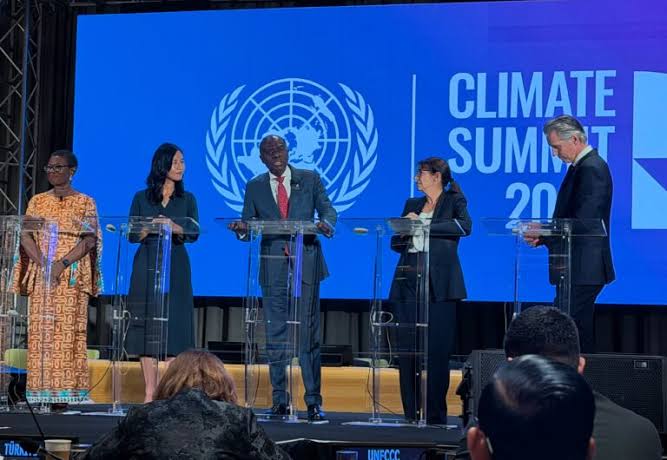
Sanwo-Olu made the call on Wednesday at the United Nations High-level Meeting on Climate Action and the Just Transition in New York, where he joined other subnational leaders, including California Governor Gavin Newsom, to discuss practical responses to the global climate challenge.
The September 23 meeting was part of the high-level week of the 81st Session of the United Nations General Assembly and focused on accelerating the energy transition, mobilising affordable finance and strengthening adaptation and resilience. The UN said the gathering brought together governments, financial institutions, businesses and subnational authorities to advance practical climate solutions.
For Sanwo-Olu, the central argument was that climate action in a rapidly expanding commercial city such as Lagos cannot be separated from economic development.
“For Lagos, climate action is about turning ambition into opportunity: protecting our people, strengthening our economy and building a more resilient and prosperous State for generations to come,” the governor said.
“Climate action is not separate from development. It is central to how we build our future.”
Lagos Links Climate Action to Economic Development
With Lagos facing challenges ranging from flooding and rising sea levels to extreme urban heat, Sanwo-Olu said the state must simultaneously strengthen resilience and continue expanding an economy supporting millions of residents.
He told the gathering that Lagos has a population of more than 22 million people, making the scale of its environmental and infrastructure challenges particularly significant.
The governor identified transportation and waste management as two areas where Lagos believes climate policies can produce wider economic benefits.
According to the state government’s statement, more than 5.2 million vehicles operate on Lagos roads, creating a major opportunity to transition towards cleaner and more efficient transportation.
The state also processes more than 5,000 tonnes of solid waste daily, which Sanwo-Olu said could increasingly be transformed into economic value through recycling, circular-economy initiatives and clean-energy solutions.
“These are not abstract climate policies. They are decisions that can create jobs, improve services, strengthen resilience and make everyday life better for millions of people,” he said.
The figures were supplied by the Lagos State Government in its statement accompanying the governor’s UN appearance.
Sanwo-Olu Calls for Long-Term Capital
Financing formed a major part of the governor’s message to international investors and development institutions.
Sanwo-Olu argued that subnational governments may have ambitious climate programmes but require affordable capital with longer repayment horizons to convert plans into physical infrastructure.
“Our message from Lagos is simple: States, Regions and subnational governments are ready to deliver,” he said.
“We have the ambition. We have the responsibility. And increasingly, we have the solutions. Now we need to build the partnerships and mobilise the investment that will allow us to deliver them at scale.”
His call aligns with one of the central themes of this year’s UN climate gathering, where mobilising and scaling affordable finance and investment for developing countries was identified as a priority.
For Lagos, access to such capital could support investment in transport, drainage, waste management, renewable energy and other infrastructure intended to make the city more resilient.
Lagos, California Partnership Takes Global Stage
Sanwo-Olu also highlighted Lagos’ developing relationship with California, saying partnerships between subnational governments could strengthen the response to climate and development challenges.
“I am particularly proud to stand here alongside Governor Newsom of California. We need strong partnerships and collaborators. No one can do it alone,” he said.
Newsom also participated in the UN high-level climate event, where California emphasised the role of states, cities and regions in implementing practical climate policies.
Sanwo-Olu’s appearance came less than a week after his visit to Sacramento in connection with the California Legislature’s Sister State Resolution involving Lagos, according to the Lagos State Government’s statement.
The relationship adds another international dimension to Lagos’ effort to attract investment and technical cooperation around clean transportation, climate resilience and sustainable urban development.
Climate Investment Becomes Business Opportunity
Beyond the environmental implications, the Lagos government’s position increasingly presents climate investment as an economic-development strategy.
Investment in cleaner transportation can create opportunities around electric mobility, charging infrastructure and public transportation, while recycling and waste-to-value projects could attract private capital into the circular economy.
Climate-resilient infrastructure is also particularly important for businesses because flooding and other extreme weather events can disrupt roads, supply chains, commercial premises and workforce mobility.
Sanwo-Olu therefore urged investors and development finance institutions to view climate projects in emerging markets not simply as environmental interventions but as investment opportunities.
The UN says the broader climate summit is seeking stronger international cooperation around energy transition, energy security, climate justice and protection against worsening climate impacts.
For Lagos, Sanwo-Olu’s message was that much of the implementation will ultimately happen below the national level, making states and cities critical partners in translating international commitments into projects that directly affect businesses and communities.
The UN engagement formed part of Sanwo-Olu’s programme during UNGA 81 and Climate Week NYC, where the Lagos State Government said he also participated in the Global Renewables Summit Leaders’ Dialogue, the Gates Foundation Goalkeepers programme and a UN Global Compact Africa-Caribbean session.