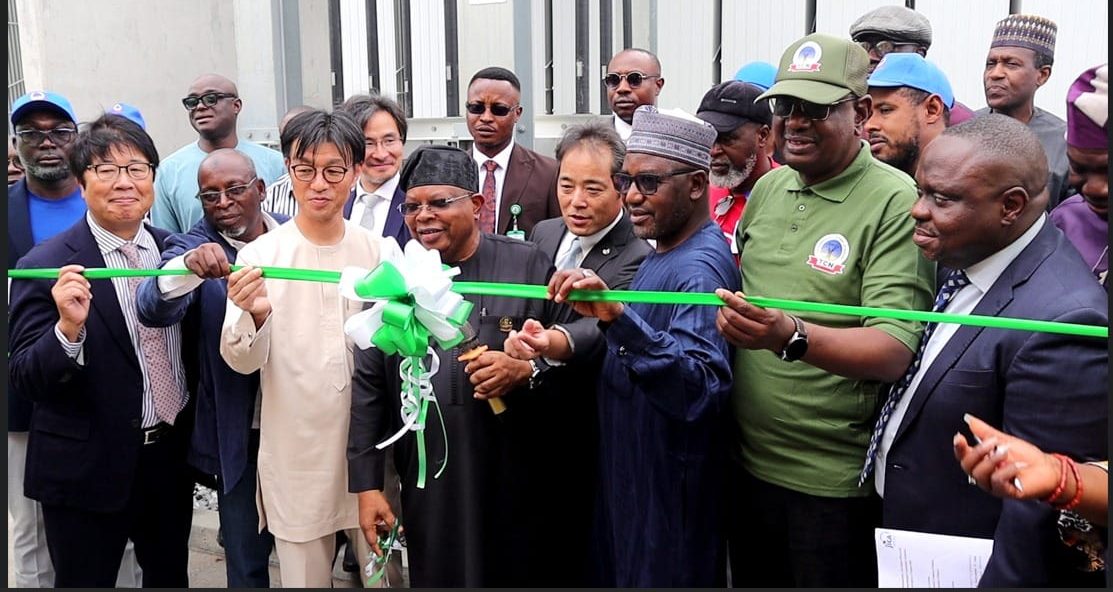
The Federal Government has commissioned transformer projects across four transmission substations in Lagos State, adding 840MVA of transformer capacity to the Transmission Company of Nigeria (TCN) network.
The projects, commissioned on Monday, August 17, and Tuesday, August 18, 2026, comprise seven 132/33kV power transformers and one 330/132/33kV transformer.
The interventions include two 60MVA transformers at the Apapa Transmission Substation, two 100MVA transformers at Ijora, a 100MVA transformer at Alausa and two 60MVA transformers at the Lekki Transmission Substation, alongside a 300MVA transformer at Lekki.
According to the Ministry of Power, the projects added 540MVA of transformer capacity at the 132kV level, with the ability to wheel about 432MW.
A further 300MVA of capacity was added at the 330kV level, providing the capability to transmit about 240MW across the Lagos transmission network.
Speaking during the commissioning, Minister of Power Joseph Tegbe said the projects represented more than the installation of new equipment, describing them as targeted investments designed to support economic growth.
“They represent targeted investments in capacity, capacity for businesses to grow, capacity for industries to produce, and capacity for communities to prosper,” Tegbe said.
The Lekki and Alausa projects were commissioned on Tuesday.
At the Lekki Transmission Substation, the intervention comprises a 300MVA, 330/132/33kV transformer and two 60MVA, 132/33kV transformers.
Tegbe said the project had effectively doubled the capacity of the Lekki 330/132/33kV Transmission Substation, which serves one of Nigeria’s fastest-growing economic corridors.
Transformer capacity at the 330/132kV level increased from 300MVA to 600MVA, equivalent to approximately 480MW, while capacity at the 132/33kV level rose from 120MVA to 240MVA, equivalent to approximately 192MW.
The project also delivered nine new 33kV feeders to improve bulk power delivery to the Eko Electricity Distribution Company (EKEDC) network.
The minister said the additional capacity would improve the reliability and availability of bulk electricity supplied to EKEDC for onward distribution to industries, businesses and households in Lekki and surrounding areas.
He stressed that the new feeders were necessary to ensure the additional transformation capacity could be effectively evacuated.
“Lekki represents the Nigeria we are building towards, a more industrial, more commercially active, more connected to global markets and increasingly attractive to domestic and international capital,” Tegbe said.
“As investment flows into a corridor such as this, electricity infrastructure cannot be an afterthought.”
At the Alausa Transmission Substation, the minister commissioned a new 100MVA, 132/33kV transformer.
The intervention increased the substation’s total transformation capacity from 135MVA to 205MVA, equivalent to approximately 164MW.
It also increased the quantum of bulk power available to the Ikeja Electricity Distribution Company (IKEDC) by 80MW for onward distribution to consumers within its franchise area.
Tegbe described the Alausa project as a deliberate effort to strengthen strategic locations across the country.
“Ikeja is where the ambition of Nigeria meets the industrious nature of Nigerians,” he said.
The minister said the Lekki and Alausa projects reflected the Federal Government’s strategy of directing electricity infrastructure towards locations where increased power supply could unlock production, investment, employment and economic value.
The commissioning exercise began on Monday with the commissioning of a 2x60MVA Gas Insulated Substation (GIS) at the Apapa Transmission Substation.
The project was delivered by the Japan International Cooperation Agency (JICA) under its Official Development Assistance programme.
The facility comprises two 60MVA, 132/33kV power transformers, new 132kV and 33kV GIS switchgear, a new control building, modern protection and control systems, Substation Automation Systems and Supervisory Control and Data Acquisition (SCADA) infrastructure.
The project is expected to improve the operation and monitoring of the transmission facility while increasing bulk power availability in the Apapa axis by approximately 96MW.
Also commissioned on Monday was the upgrade of the Ijora Transmission Substation, where two existing 30MVA transformers were replaced with two modern 100MVA, 132/33kV transformers.
The upgrade increased the substation’s total installed capacity from 90MVA to 230MVA, equivalent to approximately 184MW, providing an additional 112MW of transmission capacity.
Tegbe said the intervention would improve power supply to Ijora, Costain, Oyingbo, Customs and adjoining communities while supporting commercial activities and electricity consumers within the EKEDC franchise area.
The minister said the projects were part of a broader nationwide effort to address transmission constraints and strengthen electricity infrastructure in areas with significant economic activity.
“What we are witnessing in Lekki, Alausa and across the country is part of a broader effort to strengthen transmission infrastructure nationwide. Our transmission challenges did not emerge overnight, and they will not disappear through one intervention,” he said.
Tegbe said the government’s approach would focus on identifying transmission bottlenecks, investing in constrained areas, expanding substations where necessary and replacing ageing equipment threatening reliability.
He added that industrial and commercial corridors requiring stronger electricity infrastructure would be prioritised for investments capable of unlocking economic activity.
The minister said the commissioned projects were not the end of the Federal Government’s efforts to strengthen Nigeria’s transmission network.
“The Federal Government’s ambition is larger than the projects commissioned today. We are building towards a Nigeria where electricity is not merely a social service, but the foundation for industrial competitiveness and economic growth, and where investment decisions are driven by opportunity rather than infrastructure constraints,” he said.