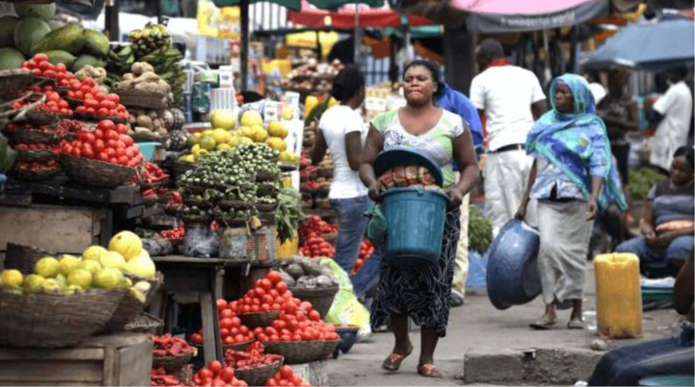
Food inflation remained a major economic concern in Nigeria in October 2026, with 19 states recording annual food inflation rates above 20 per cent despite a moderation in the country’s overall food inflation figure.
The latest development highlights the continuing pressure on household purchasing power and the challenges facing millions of Nigerians as food prices remain elevated across several parts of the country.
Figures from the National Bureau of Statistics (NBS), as reported by BusinessDay, showed that more than half of Nigeria’s 36 states experienced annual food inflation above 20 per cent during the period.
Ondo State recorded the highest annual food inflation rate at 31.74 per cent, followed by Lagos State at 31.43 per cent and Imo State at 29.75 per cent.
Oyo State recorded 28.81 per cent, while Ebonyi State posted 27.96 per cent.
The figures indicate that food inflation remains uneven across the country, with consumers in some states experiencing significantly higher increases than the national average.
At the national level, annual food inflation moderated to 19.13 per cent in October.
Although the reduction represents an improvement compared with previous inflation readings, it does not mean that food prices have returned to earlier levels.
Inflation measures the rate at which prices increase over time. Therefore, a decline in the inflation rate generally means prices are increasing more slowly rather than falling.
This distinction remains important for Nigerian households, many of which continue to spend a significant portion of their income on food.
The pressure is particularly challenging for low-income families, whose earnings may not increase at the same pace as the cost of essential commodities.
Food inflation also affects businesses across the agricultural value chain, including farmers, food processors, transport operators, wholesalers and retailers.
When the cost of producing and transporting food increases, businesses may transfer part of the additional expenses to consumers.
Several factors influence food prices in Nigeria, including transportation costs, agricultural production expenses, insecurity in farming communities, storage challenges and seasonal supply variations.
The country’s dependence on road transportation also means that higher fuel and logistics costs can affect the final prices of agricultural products.
In addition, inadequate storage facilities contribute to post-harvest losses, particularly for perishable commodities such as tomatoes, vegetables and fruits.
These challenges can reduce the quantity of food reaching urban markets and create additional pressure on prices.
For farmers, higher production costs can affect profitability and limit their ability to expand cultivation.
The cost of fertilisers, improved seeds, machinery, pesticides and other agricultural inputs remains an important consideration when determining the prices of harvested products.
The latest figures also raise questions about the effectiveness of measures aimed at improving agricultural productivity and food distribution.
Government policies targeting local food production, rural infrastructure, agricultural financing and improved storage facilities could help address some of the structural challenges affecting the sector.
Improving security in farming communities is also important because farmers require safe access to their land to maintain production levels.
Nigeria’s food inflation challenge is not only an economic issue but also a development concern because access to affordable food directly affects household welfare.
When food prices rise faster than income, families may reduce consumption, change their diets or spend less on other essential needs such as education, healthcare and transportation.
For businesses, elevated food prices can influence wage demands, operating expenses and consumer spending patterns.
The October figures therefore demonstrate that although national food inflation has moderated, the cost-of-living challenge remains significant in several states.
Sustained improvements in agricultural production, transportation, storage and distribution will be important in ensuring that lower inflation eventually translates into more affordable food for Nigerian consumers.