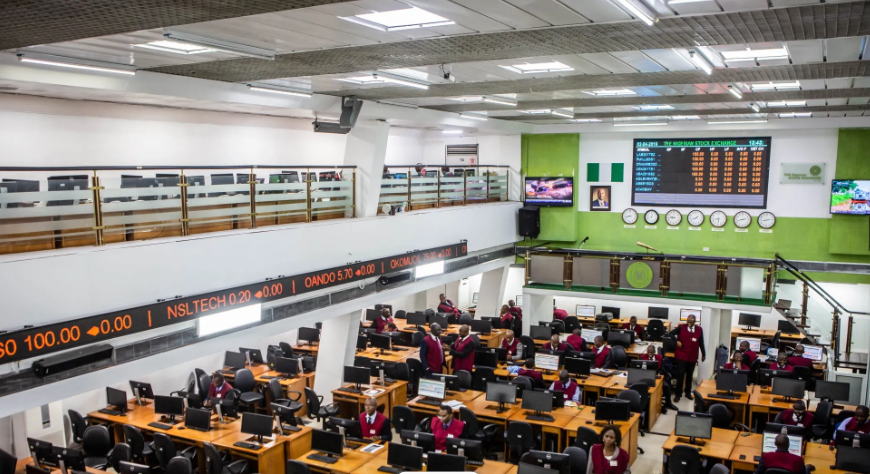
The Nigerian Exchange Limited (NGX) has recorded another decline in market value, with investors losing approximately N767.36 billion following renewed selling pressure across major sectors of the equities market.
The bearish performance extended the exchange’s losing streak to five consecutive trading sessions, reflecting growing caution among investors as financial market participants reassess their positions in major listed companies.
At the close of trading on Monday, November 23, 2026, the NGX All-Share Index declined by 0.48 per cent to settle at 246,478.90 points, compared with 247,660.74 points recorded at the previous trading session.
Market capitalisation also dropped from approximately N160.80 trillion to N160.04 trillion, representing a reduction of about N767.36 billion.
The decline was largely driven by selling pressure in banking, industrial, consumer goods and oil and gas stocks.
According to market data reported by Nairametrics and Proshare, several heavyweight companies recorded losses during the session, contributing to the broader decline in the market.
Fidelity Bank experienced a notable decline of 7.34 per cent, while Julius Berger Nigeria fell by 9.97 per cent.
Other companies that recorded losses included Oando, Access Holdings, First HoldCo, Zenith Bank and Guaranty Trust Holding Company.
The banking sector remained one of the major contributors to the market’s negative performance.
Fidelity Bank declined by 7.34 per cent, Access Holdings lost 2.28 per cent, First HoldCo fell 2.09 per cent, while Zenith Bank and GTCO recorded declines of 1.81 per cent and 1.75 per cent respectively.
The industrial sector also experienced significant pressure, with Julius Berger among the major decliners.
International Breweries and other consumer-related companies equally contributed to the negative performance.
However, the market did not experience losses across every sector.
The insurance sector recorded positive performance, supported by buying interest in several insurance companies.
Cornerstone Insurance gained 10 per cent, while AIICO Insurance advanced by 9.87 per cent. Linkage Assurance also recorded a gain of 9.80 per cent.
These performances demonstrated that some investors continued to identify opportunities in selected stocks despite the general market weakness.
Trading activity increased during the session, with approximately 441.07 million shares exchanged in 38,846 deals.
The volume represented an increase of 44.32 per cent compared with the previous trading session.
The increase in trading volume suggests that investors remained active despite the negative direction of the market.
Market breadth, however, remained negative, with 20 equities recording gains against 39 decliners.
The latest performance comes after a period of significant activity in the Nigerian stock market, which has attracted investor interest due to corporate earnings, banking sector developments and expectations surrounding the country’s economic outlook.
Nevertheless, market participants are becoming increasingly attentive to developments affecting interest rates, inflation, currency stability and government borrowing.
These factors influence investment decisions because they determine the relative attractiveness of equities compared with fixed-income instruments.
When government securities offer competitive returns, some investors may choose to reduce their exposure to equities, particularly during periods of uncertainty.
The ongoing pressure on the naira and expectations surrounding the CBN’s November monetary policy decision could also influence market sentiment.
For listed companies, a prolonged decline in share prices may affect market valuation and investor confidence, although daily market movements do not necessarily reflect the underlying financial performance of individual businesses.
Investors are therefore expected to continue monitoring corporate earnings, dividend announcements and regulatory developments when making investment decisions.
The NGX’s five-session losing streak highlights the importance of market confidence and the influence of broader economic conditions on Nigeria’s capital market.
Although the decline represents a setback for investors, the performance of individual sectors suggests that opportunities remain available in selected equities.