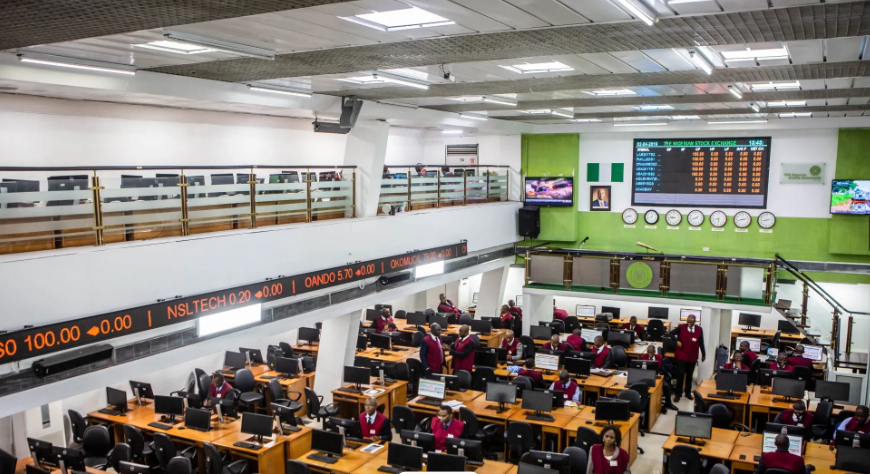
The Nigerian Exchange Limited (NGX) extended its losing streak to seven consecutive trading sessions as investors continued to reduce their exposure to equities, resulting in a significant decline in the market’s overall value.
The sustained selling pressure reportedly wiped approximately ₦1.10 trillion off the market during the period, reflecting growing caution among investors amid changing market conditions.
The development highlights the volatility currently facing Nigeria’s equities market as investors reassess their portfolios and respond to developments affecting the country’s financial environment.
According to a report published by The Business Times Nigeria on November 25, 2026, the market’s downward movement continued for a seventh consecutive session, extending losses recorded in previous trading days.
The prolonged decline has drawn attention to investor sentiment and the factors influencing trading activities on the Nigerian Exchange.
Investors continue to reduce equity exposure
A losing streak occurs when a stock market records declines across consecutive trading sessions.
During such periods, investors may reduce their holdings because of concerns about future returns, economic uncertainty or expectations of weaker share-price performance.
The latest decline suggests that selling activities have continued to outweigh buying interest across the market.
When investors sell more shares than buyers are willing to purchase at prevailing prices, share values may come under pressure.
This can affect individual companies as well as the overall market capitalisation.
The reported ₦1.10 trillion reduction represents a significant amount of market value and demonstrates the financial impact of sustained selling activities.
However, a decline in market capitalisation does not necessarily mean that investors have withdrawn the entire amount of money represented by the loss. Market capitalisation changes as share prices move.
Factors influencing market performance
Several factors can influence the performance of the Nigerian equities market.
Interest rates, inflation, corporate earnings, foreign exchange movements and government economic policies are among the major considerations affecting investment decisions.
When interest rates remain relatively high, some investors may prefer fixed-income securities because they offer alternative returns without the same level of exposure to daily stock market fluctuations.
Treasury bills and other money market instruments can become attractive to investors seeking more predictable investment opportunities.
Corporate earnings also play an important role.
Companies that report strong profits and maintain positive business outlooks may attract investor interest, while weaker financial results can encourage selling.
In addition, uncertainty surrounding economic developments may cause investors to adopt more cautious investment strategies.
Dangote Refinery listing attracts market attention
The anticipated listing of Dangote Petroleum Refinery and Petrochemicals on the Nigerian Exchange on December 1, 2026, is another major development attracting attention within the investment community.
The company’s planned market debut follows regulatory approval of its share allocation arrangement.
The refinery’s initial public offering reportedly attracted substantial investor demand, making it one of the most closely watched capital market developments of the year.
Investors may be reassessing their portfolios ahead of the listing as they consider opportunities in the new offering and the performance of existing equities.
However, the refinery’s planned listing should not be regarded as the established cause of the NGX’s seven-session decline.
Other market conditions, including interest rates, liquidity and company-specific developments, may also influence investor decisions.
Implications for investors and listed companies
A prolonged market decline can create challenges for investors, particularly those whose portfolios are heavily concentrated in equities.
Falling share prices may reduce the market value of investment holdings and affect short-term investment returns.
For listed companies, weaker market sentiment can also affect their ability to attract new investors and raise additional capital through the stock market.
Nevertheless, market corrections can sometimes create opportunities for investors who identify fundamentally strong companies trading below their estimated long-term value.
Investment decisions should therefore be based on financial performance, business prospects, valuation and individual risk tolerance rather than short-term market movements alone.
Outlook for the Nigerian Exchange
The direction of the NGX in the coming trading sessions will depend on investor confidence, corporate earnings, monetary policy developments and broader economic conditions.
Market participants will also monitor liquidity conditions and developments surrounding major corporate listings.
A recovery in buying interest could help stabilise share prices, although sustained improvement will require stronger investor confidence.
For now, the seven-session losing streak serves as an indication of the cautious mood affecting Nigeria’s equities market.
Investors will be watching closely to determine whether the market can reverse its downward movement or extend the current period of losses.