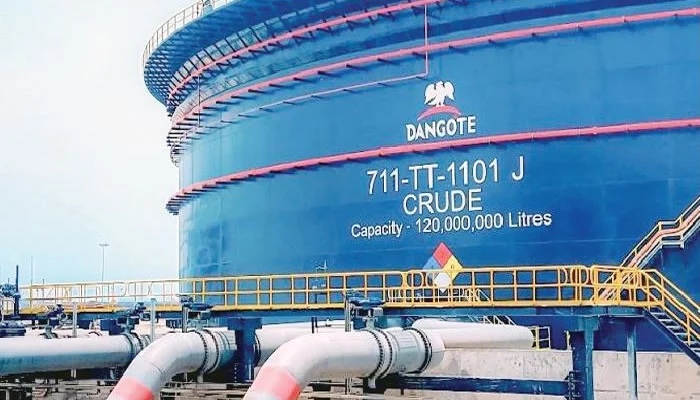
Dangote Refinery emerged as the world’s largest exporter of jet fuel in April following disruptions in global fuel trade caused by the Middle East conflict.
The development was disclosed in a recent report by S&P Global, which featured comments from the refinery’s Chief Executive Officer, David Bird, during an interview conducted at the facility in Nigeria.
According to the report, changing global supply patterns increased demand for alternative aviation fuel suppliers, positioning Dangote Refinery as a major beneficiary of the disruption.
S&P Global Energy stated that jet fuel became a key driver of export growth in April as global supply disruptions redirected aviation fuel trade flows across major markets.
Data from S&P Global Commodities at Sea showed that the refinery became the world’s largest exporter of aviation fuel after the Middle East conflict disrupted established supply routes.
“After the Middle East war began, Dangote shifted to ‘max jet mode,’ and in April it became the world’s single largest exporter of aviation fuel,” the report stated.
The refinery has now reached its full production capacity of about 650,000 barrels per day after completing a gradual ramp-up phase and maintaining near-peak operational levels.
The facility has also adopted a flexible blending system by importing feedstocks such as GTL naphtha and Bonny condensate to increase gasoline yields beyond its original design configuration.
Bird said operating at full scale requires stronger trading expertise, improved logistics coordination, and more reliable supply chains as the refinery expands beyond local crude limitations.
The report added that the refinery is transitioning into a merchant refining model, where it actively trades crude oil and refined petroleum products in global markets instead of operating solely as a domestic processor.
According to the report, the refinery is expanding its crude processing capacity beyond Nigerian light sweet crude to include heavier grades and residue blends. The facility can currently process around 40 different crude grades, with plans to increase the number over time.
Bird disclosed that the refinery is targeting a future production capacity of 1.4 million barrels per day, which would require sourcing additional crude from the United States, the Middle East, and parts of South America.
He added that the company is pursuing long-term supply agreements with governments, airlines, and national oil companies as it gradually moves away from spot-market sales.
The refinery is also investing in regional infrastructure projects, including proposed storage and logistics hubs in Namibia, pipeline discussions in Zambia, and storage expansion plans across Central and East Africa.
Bird said the long-term vision is to transform the Lekki Free Zone into a major industrial and energy hub driven by refining, petrochemicals, and export logistics integration.
The Middle East conflict involving the United States, Iran, and Israel disrupted global energy markets after Iran threatened and intermittently restricted movements around the Strait of Hormuz, a major shipping route responsible for roughly 20 per cent of global oil and fuel trade.
The disruption tightened global fuel supply chains and pushed international jet fuel prices higher, creating opportunities for suppliers outside the Middle East.
The rise in jet fuel prices also increased pressure on Nigeria’s aviation sector, prompting the Federal Government in April to introduce a price cap and a 30-day credit window for airlines to ease operating costs.
Under the intervention coordinated by the Nigerian Midstream and Downstream Petroleum Regulatory Authority, Jet A1 prices were guided within benchmark ranges of N1,760 to N1,988 per litre in Lagos and N1,809 to N2,037 per litre in Abuja.
Earlier in May, Dangote Petroleum Refinery reduced the ex-depot price of aviation fuel from N1,750 to N1,650 per litre and introduced a 30-day interest-free credit facility for marketers and airline operators.
The refinery also announced that it had transitioned Jet A1 transactions from dollar-based pricing to naira-denominated sales as part of efforts to stabilise supply and reduce pressure on domestic airline operators.