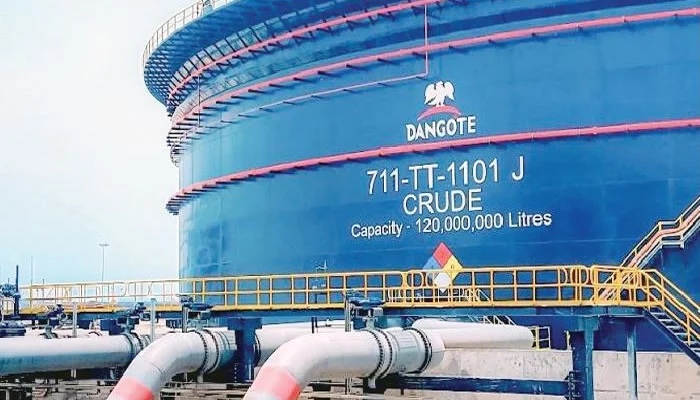
Dangote Petroleum Refinery imported approximately 1.46 billion litres of gasoline blendstock and intermediates between January and May 2026 to support its fuel production operations, according to the latest industry data released by the Nigerian Midstream and Downstream Petroleum Regulatory Authority (NMDPRA).
The statistics, contained in the NMDPRA’s Midstream and Downstream Petroleum Report for May 2026, indicate that the 650,000 barrels-per-day refinery continued to supplement crude oil processing with imported gasoline blendstocks to sustain high levels of Premium Motor Spirit (PMS) production and maintain operational efficiency.
Gasoline blendstocks are intermediate petroleum products used in refining operations to produce finished petrol that meets required quality, octane and environmental standards. They are not sold directly to consumers but are blended with refinery streams and additives to increase fuel output and improve product quality.
An analysis of the report showed that Dangote Refinery imported 658.31 million litres of gasoline blendstock in January, 306.89 million litres in February, 102.35 million litres in March, 147.37 million litres in April and 240.59 million litres in May.
The cumulative volume imported during the five-month period stood at about 1.46 billion litres.
The data revealed that after three consecutive months of declining imports between January and March, the refinery increased its blendstock purchases in April and May as production activities expanded.
The May import volume of 240.59 million litres represented a 63.3 per cent increase from the 147.37 million litres recorded in April.
The increase coincided with some of the refinery’s strongest production indicators since it commenced large-scale operations.
According to the NMDPRA report, the refinery achieved an average capacity utilisation rate of 101.25 per cent in May, exceeding its installed nameplate capacity.
During the same period, the refinery produced an average of 44.7 million litres of Premium Motor Spirit daily. Of this volume, about 41.5 million litres per day were supplied to the domestic market, while closing stock stood at 9.4 million litres.
The refinery also produced 24.5 million litres of Automotive Gas Oil (diesel) daily. Local supply accounted for 18.2 million litres, while 6.5 million litres were exported.
For aviation fuel, daily production reached 21.9 million litres, with domestic supply at 2.8 million litres and exports averaging 17.5 million litres per day.
The report further showed that Dangote Refinery continued to process a combination of domestic and imported crude oil.
In May, domestic crude supply to refineries stood at 15.84 million barrels, while imported crude contributed 2.08 million barrels, bringing total crude receipts to 17.92 million barrels.
This compares with April’s total crude receipts of 18.37 million barrels, comprising 17.96 million barrels of domestic crude and 410,000 barrels of imported crude.
Industry analysts noted that despite improvements in local crude supply, imported feedstocks and intermediates remain important components of the refinery’s operations.
Data trends showed that the refinery’s dependence on gasoline blendstocks declined significantly between January and March as crude oil receipts increased. Crude intake rose from 9.53 million barrels in January to 20.92 million barrels in March, while blendstock imports dropped from 658.31 million litres to 102.35 million litres over the same period.
However, the trend reversed in April and May despite strong crude receipts, suggesting that the refinery increasingly used imported blendstocks to optimise fuel production and maximise operational performance.
With a nameplate capacity of 650,000 barrels per day, the refinery would require approximately 20.15 million barrels of crude oil to operate at full capacity throughout a 31-day month. However, total crude receipts in May stood at 17.92 million barrels.
Despite receiving less crude than the theoretical requirement for full-capacity operations, the refinery recorded utilisation above 100 per cent, indicating that imported intermediates played a complementary role in boosting finished product output.
The NMDPRA report also highlighted the continued inactivity of Nigeria’s state-owned refineries.
According to the regulator, the Port Harcourt Refining Company, Warri Refining and Petrochemical Company, and Kaduna Refining and Petrochemical Company remained under shutdown status as of May 2026.
Their continued inactivity leaves Dangote Refinery as Nigeria’s largest operational refining facility and the dominant supplier of locally refined petroleum products.
Commenting on the development, Professor of Energy at the University of Lagos, Dayo Ayoade, explained that importing gasoline blendstocks is a standard global refining practice and does not indicate the importation of finished petrol.
“Gasoline feedstocks are unfinished petroleum streams such as straight run naphtha, butane, reformate, fluid catalytic gasoline and different types of streams that are basically combined and blended eventually to meet the regulatory standards of Premium Motor Spirit,” he said.
According to Ayoade, the practice enables refiners to improve fuel quality, optimise refinery operations and maximise output while maintaining compliance with environmental standards.
He added that blendstocks also provide operational flexibility, particularly when crude oil supply is unstable.
“It is not a bad thing. The only issue is the economic implication. The refinery is now at capacity, but the importation means we are leaking foreign exchange because money is leaving Nigeria to purchase these products from international markets,” he said.
He also warned that the practice could fuel misconceptions among critics who may wrongly interpret blendstock imports as imports of finished petrol products.
As Dangote Refinery continues to increase production and strengthen its role in Nigeria’s fuel supply chain, industry stakeholders say the strategic use of imported blendstocks is likely to remain an important tool for sustaining output, supporting exports and meeting growing domestic demand.