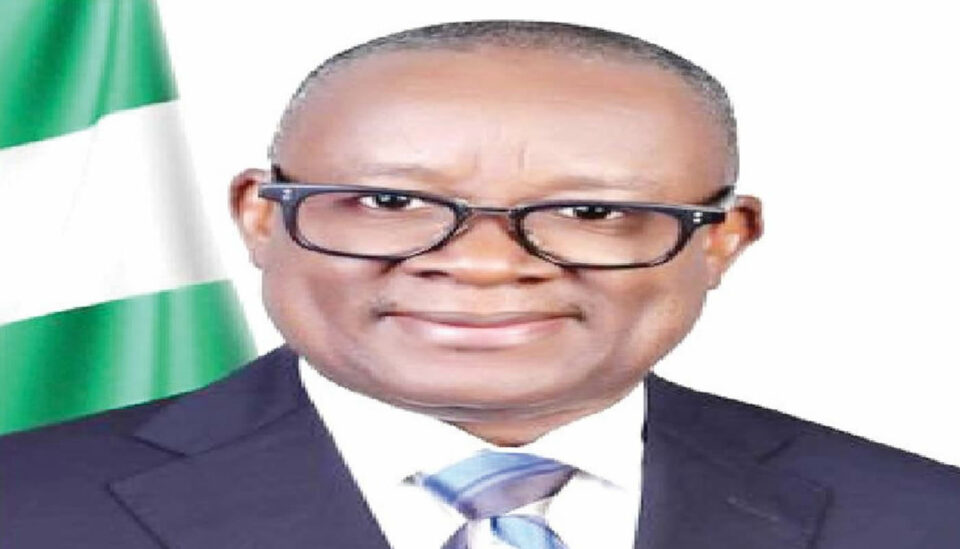
The Minister of State for Industry, Trade and Investment, John Enoh, has called for stronger corporate governance and institutional credibility as critical requirements for attracting long-term investment and building globally competitive industries in Nigeria.
Enoh made the call on Thursday in Abuja during the 11th Executive Committee Investiture Ceremony of the Abuja Zone of the Chartered Institute of Directors (CIoD) Nigeria, where Rose Eshiett was inaugurated as the new chairman of the zone.
Speaking at the event, the minister stressed that governance remains a key driver of industrial transformation, investment attraction, and sustainable economic growth.
“No nation can build globally competitive industries without strong institutions. No economy can attract patient capital without credible governance. No enterprise can endure without sound boards, disciplined management, transparent reporting, and responsible leadership,” Enoh said.
He noted that as Nigeria seeks to expand industrial capacity, boost investor confidence, and drive private-sector-led growth, the quality of leadership across public and private institutions will play a decisive role in determining the country’s success.
According to him, good governance is not merely a theoretical concept but the foundation upon which enduring institutions and trusted organisations are built.
“Good governance is not an abstract ideal. It is the foundation upon which enduring institutions are built. It is the discipline that turns ambition into performance, enterprise into legacy, and leadership into public trust,” he stated.
Enoh added that while the Federal Ministry of Industry, Trade and Investment is focused on productivity, value addition, competitiveness, and industrial development, policies alone cannot achieve meaningful results without ethical leadership and strong governance structures.
Also speaking at the event, the Head of the Civil Service of the Federation, Didi Esther Walson-Jack, emphasised the importance of strong institutions and responsible leadership in advancing national development.
She said the Federal Civil Service is implementing reforms focused on professionalism, innovation, digitalisation, accountability, and citizen-centred service delivery.
Walson-Jack called for stronger collaboration between her office and the Chartered Institute of Directors to provide governance and board leadership training for permanent secretaries and senior civil servants.
Delivering the keynote address, board member of NNPC Limited, Bello Rabiu, urged directors to adapt to a rapidly changing global environment marked by geopolitical tensions, economic uncertainty, technological disruption, and evolving stakeholder expectations.
Rabiu encouraged boards to move beyond reviewing historical performance and focus more on anticipating future risks through strategic planning and enterprise-wide risk management.
Representing the Chairman of the occasion and Founder of Heirs Holdings, Tony Elumelu, the Managing Director and Chief Executive Officer of Transcorp Hotels Plc, Uzo Oshogwe, said Nigeria requires stronger institutions and visionary leadership to accelerate economic development.
She noted that the responsibilities of corporate leaders now extend beyond profit-making to include job creation, institution-building, and social impact.
“The choice of leadership matters, especially at a time when our country requires stronger institutions, greater accountability, and more visionary leadership,” Oshogwe said.
She added that strong governance remains central to the African Capitalism philosophy championed by Elumelu.
“Without strong governance, businesses cannot fulfil their potential as engines of development,” she stated.
Earlier, the President and Chairman of the Governing Council of the Chartered Institute of Directors Nigeria, Adetunji Oyebanji, described the investiture as a significant step toward strengthening governance and leadership excellence.
He noted that the Abuja Zone occupies a strategic position within the institute because it serves as a bridge between governance, public policy, business leadership, and national development.
“The future of Nigeria’s organisations, public and private alike, will depend significantly on the quality of governance we nurture today,” Oyebanji said.
In his remarks, the Royal Father of the Day and immediate past Chairman of the Akwa Ibom State Traditional Rulers Council, HRM Odidem Bassey Etim Edet, highlighted the relationship between governance, investment, and prosperity.
“When governance improves, investment grows. When investment grows, jobs are created. When jobs are created, families prosper. When families prosper, communities thrive,” the monarch said.
In her acceptance speech, the newly inaugurated Chairman of the Abuja Zone, Rose Eshiett, pledged to strengthen the institute’s role in promoting corporate governance, leadership development, and policy advocacy.
She unveiled a three-point agenda focused on membership growth and value enhancement, strategic visibility and influence, as well as revenue growth and institutional sustainability.
“Together, we can deepen the culture of good governance, strengthen board effectiveness, promote ethical leadership, and contribute meaningfully to national development,” Eshiett said.
She added that her administration would leverage Abuja’s strategic position to engage government institutions, regulators, development partners, and the private sector through policy dialogue, governance advocacy, and strategic partnerships.