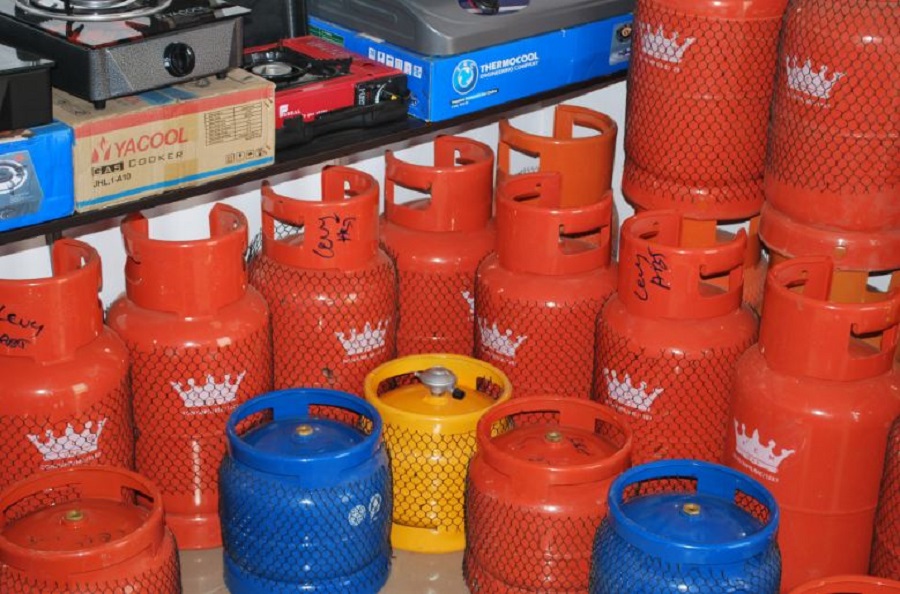
The Federal Government has directed security agencies to take decisive action against individuals and businesses undermining the Liquefied Petroleum Gas (LPG) market following a sharp increase in cooking gas prices across the country.
Minister of State for Petroleum Resources (Gas), Ekperikpe Ekpo, issued the directive on Monday during a stakeholders’ meeting convened to address the rising cost of LPG and growing concerns over supply disruptions.
Ekpo specifically instructed operatives of the Department of State Services (DSS), the Nigeria Police Force, the Nigeria Security and Civil Defence Corps (NSCDC), and other relevant security agencies to apprehend hoarders, dismantle illegal storage facilities and stop product diversion nationwide.
According to the minister, the government will not allow market manipulation to frustrate ongoing efforts aimed at ensuring the availability and affordability of cooking gas for Nigerians.
“I have directed the NMDPRA to intensify monitoring, engage operators, and work with security agencies to discourage hoarding, eliminate artificial scarcity, and strengthen distribution and pricing transparency,” Ekpo said.
He stressed that increased supply must be supported by efficient distribution systems and responsible market conduct.
“Bottlenecks, hoarding, speculative storage, allocation inefficiencies, logistics constraints, and pricing distortions must not undermine public confidence,” he added.
The minister reassured Nigerians that there was no reason for panic, insisting that the government remains committed to guaranteeing adequate domestic gas supply under the Decade of Gas Initiative.
According to him, the initiative remains a key strategy for promoting cleaner cooking energy, industrial development and national energy security.
Speaking at the meeting, Deputy President of the Nigerian Association of LPG Marketers (NALPGAM), Ude Godwin, said the gathering provided an opportunity for stakeholders to address the worsening gas supply and pricing crisis.
Godwin noted that Nigerians have experienced repeated LPG shortages and steep price increases since late 2025 despite growing domestic production capacity.
According to him, LPG prices rose from about N1,000 per kilogram in January 2026 to between N1,500 and N1,700 per kilogram by May.
He added that prices in some locations climbed further to between N2,000 and N2,500 per kilogram in June.
The marketer disclosed that the cost of a 20-metric-tonne truckload of LPG has increased significantly, rising from about N14 million when the Dangote Refinery began supplying the product in 2025 to between N28 million and N30 million currently.
Godwin attributed the price surge to erratic supply, congestion at Lagos terminals, logistics challenges and reduced product volumes from both the Dangote Refinery and the Nigeria LNG Limited (NLNG).
He also warned that limited buffer stocks have made the market highly vulnerable to disruptions, with even short supply interruptions triggering panic buying and price spikes.
To address the challenges, NALPGAM proposed several interventions, including stricter enforcement of domestic supply obligations for local LPG producers.
The association urged the government to ensure that adequate volumes are supplied to the domestic market before exports are considered.
Godwin also recommended the establishment of a joint government-industry monitoring team to track production volumes, inventory levels, depot prices and distribution patterns nationwide.
According to him, such a mechanism would help identify early signs of shortages, speculative activities and market distortions before they escalate.
The association further called for an urgent review of multiple fees, levies and charges imposed across the LPG value chain to reduce operating costs and ease pressure on retail prices.
NALPGAM also advocated a fast-track framework for LPG imports whenever domestic supply falls short, including easier access to foreign exchange and streamlined regulatory approvals.
The marketers stressed the need for increased investment in storage facilities and distribution infrastructure, particularly in Northern Nigeria and other underserved regions, to improve nationwide availability and reduce transportation costs.
In addition, the association proposed the creation of a standing working group comprising representatives of the Ministry of Petroleum Resources, the Nigerian Midstream and Downstream Petroleum Regulatory Authority (NMDPRA), producers, terminal operators and marketers.
The group, it said, would meet regularly to monitor implementation of agreed interventions and ensure effective policy coordination.
Industry stakeholders believe that sustained collaboration between government agencies and private operators will be critical to stabilising the LPG market and restoring affordability for millions of households that rely on cooking gas as a primary energy source.