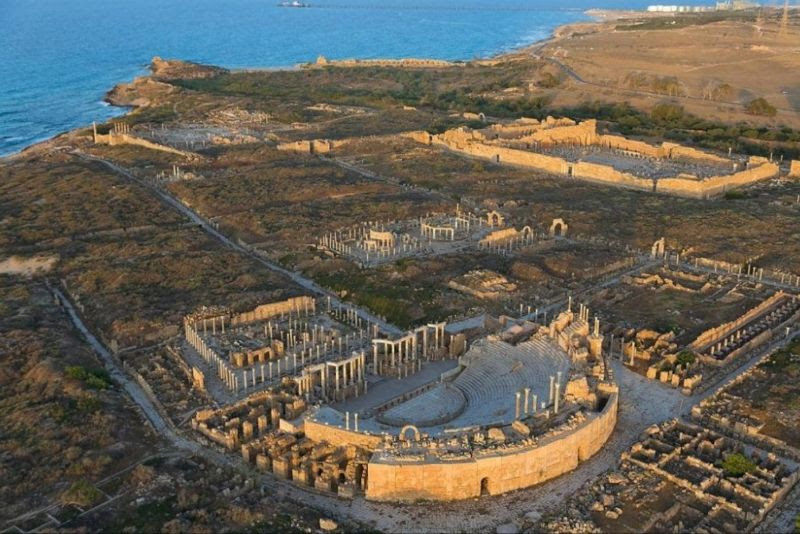
About 120 kilometres east of Tripoli, on Libya’s Mediterranean coast, the remains of Leptis Magna preserve one of North Africa’s most striking windows into the ancient world.
Founded by the Phoenicians before rising to prominence under Roman rule, the city developed into an important commercial centre connecting Africa with the wider Mediterranean.
Its surviving streets, baths, forum, basilica, theatre and monumental architecture today provide physical evidence of the economic and cultural exchanges that shaped the region centuries ago.
Leptis Magna’s importance lies not simply in the survival of individual buildings but in the scale at which visitors can still encounter the structure of an ancient city.
Trade Helped Build Ancient Prosperity
The city’s location on the Mediterranean placed it within trading networks connecting North Africa with other parts of the ancient world.
Leptis Magna prospered through trade before becoming an important Roman centre.
That commercial history is significant because it demonstrates that ancient North Africa was deeply connected to wider Mediterranean economic systems.
Goods, people and ideas moved through these networks, allowing coastal settlements to develop into major urban centres.
Leptis Magna consequently represents more than Roman expansion into Africa. Its history also reflects Africa’s own position within Mediterranean trade.
Septimius Severus Transforms the City
The city’s prominence increased further through its association with Emperor Septimius Severus, who was born at Leptis Magna.
During his rule, major architectural development transformed the city, leaving monumental structures that remain visible.
Among the best-known is the Arch of Septimius Severus.
The monument stands alongside an extensive collection of surviving urban features that help visitors understand the scale and sophistication of the ancient settlement.
Baths, Forum and Basilica Survive
Visitors can still encounter expansive baths, a forum, basilica, streets and colonnades.
Together, these structures provide more than isolated archaeological attractions.
They help reconstruct how the city functioned.
Public spaces reveal where civic and commercial activities occurred, while roads and colonnades demonstrate how different sections of the settlement were connected.
Walking through such remains allows visitors to experience ancient urban planning at a scale that individual museum objects cannot easily communicate.
Theatre Looks Towards Mediterranean
The ancient theatre is another particularly notable feature.
Its combination of Roman architecture and views towards the Mediterranean provides a reminder that Leptis Magna’s geography was fundamental to its identity.
The sea was not merely a scenic backdrop.
It connected the city to the trading and cultural networks through which it prospered.
That relationship between architecture and landscape is part of what gives the archaeological site its distinctive character.
Dunes Help Preserve Ancient Architecture
One of the reasons so much architectural detail has survived is unusual.
According to the supplied material, sand dunes helped protect sections of the city from modern construction and other forms of damage, preserving structures that might otherwise have disappeared.
The gradual covering of ancient remains can make archaeological discovery more difficult, but it can also shield structures from later human activity.
As a result, modern visitors can still see substantial evidence of the city’s architecture.
An African Chapter of Mediterranean History
Leptis Magna challenges overly simple divisions between “African” and “European” ancient history.
The Mediterranean historically connected societies as much as it separated them.
The city developed on African soil, emerged from Phoenician foundations, flourished within the Roman world and produced an emperor who would become one of Rome’s most significant rulers.
Its surviving architecture consequently tells a story of cultural and economic connections between Africa and the Mediterranean world.
For Libya, Leptis Magna is therefore more than an archaeological attraction.
It is evidence of the country’s place within a much longer history of trade, urbanisation and cultural exchange.
Thousands of years after merchants and residents walked its colonnaded streets, the remains continue to demonstrate how deeply North Africa was integrated into the networks of the ancient Mediterranean.