

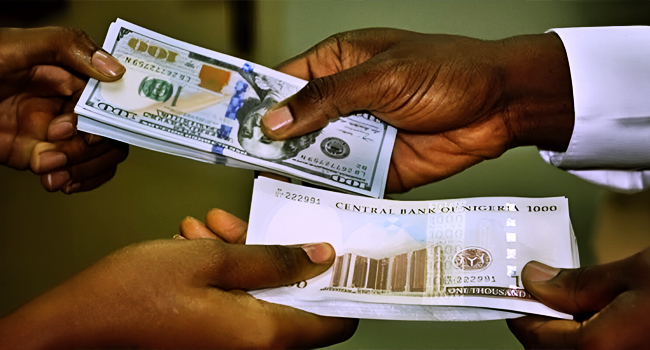
The Nigerian naira depreciated against the United States dollar at the official foreign exchange market on Tuesday, October 13, 2026, closing at ₦1,333.84 per dollar as demand and supply conditions continued to influence currency trading.
The development came despite an improvement in Nigeria’s gross external reserves, which stood at $55.08 billion as of October 9, according to the latest market figures released by Cordros Securities.
The Daily Market Update showed that the naira weakened by approximately 0.17 per cent compared with the previous trading session, when the official exchange rate stood at ₦1,331.56 per dollar.
The latest movement represents a depreciation of ₦2.28 against the dollar.
However, the local currency maintained a positive year-to-date performance, reflecting its stronger position compared with the beginning of 2026.
Naira Records Modest Decline
According to Cordros Securities, the official exchange rate settled at ₦1,333.84 per dollar.
This represents a 0.17 per cent depreciation during the trading session.
The movement followed the currency’s stronger performance in the preceding session.
Although the daily decline was relatively modest, exchange rate changes remain important for businesses and individuals who require foreign currency for international transactions.
Importers, manufacturers and companies with dollar-denominated obligations are particularly sensitive to movements in the exchange rate.
A weaker naira increases the local currency amount required to purchase a given quantity of dollars.
However, the effect on business costs depends on the timing of transactions, access to foreign exchange and other operating expenses.
External Reserves Reach $55.08bn
The market update placed Nigeria’s gross external reserves at $55.08 billion as of October 9, 2026.
This compares with $45.57 billion at the beginning of the year.
The difference represents an increase of approximately $9.51 billion.
The improvement is significant because external reserves are an important component of Nigeria’s international financial position.
They can support confidence in the country’s ability to meet foreign currency obligations and respond to external financial pressures.
However, a stronger reserve balance does not automatically guarantee daily appreciation of the naira.
Exchange rates remain influenced by market conditions and the availability of foreign currency.
Currency Maintains Year-to-Date Gain
Despite the latest depreciation, Cordros reported that the naira retained a year-to-date appreciation of 7.58 per cent.
The figure indicates that the local currency remained stronger against the dollar than at the beginning of 2026.
This performance provides a broader perspective on the currency’s movement.
Daily exchange rate fluctuations can occur even during periods of relative stability or sustained appreciation.
For businesses, however, predictable access to foreign exchange may be as important as the exchange rate itself.
Companies require reliable currency availability to plan purchases, settle obligations and manage production costs.
Why External Reserves Matter
Foreign exchange reserves can provide an indication of a country’s capacity to meet external obligations.
They may also support investor confidence and provide resources for responding to financial market disruptions.
Nevertheless, the gross reserve figure does not reveal how much is immediately available for intervention or other uses.
The composition of reserves and associated obligations are also important.
For Nigeria, sustained foreign exchange inflows from exports, investment and other legitimate sources remain central to long-term currency stability.
Businesses Continue to Monitor Exchange Rate
Exchange rate movements have implications for several sectors of the Nigerian economy.
Manufacturers that import machinery or raw materials may face higher costs when the naira depreciates.
Technology companies and service providers paying for foreign software or equipment may also be affected.
Businesses with foreign currency loans can experience changes in the naira value of their obligations.
At the same time, exporters earning dollars may receive a higher naira equivalent for their foreign currency proceeds.
The overall impact therefore differs across industries.
Monetary Conditions Shape Market Expectations
The Cordros report also placed Nigeria’s Monetary Policy Rate at 23 per cent.
The inflation rate was reported at 15.39 per cent.
These indicators provide context for the financial environment in which the naira is traded.
Interest rates can influence investment decisions and demand for naira-denominated financial assets.
Inflation affects domestic purchasing power and business operating costs.
However, the report did not identify a specific monetary policy announcement as the cause of the October 13 depreciation.
Outlook Depends on Foreign Exchange Liquidity
The direction of the naira will continue to depend on foreign exchange inflows, import demand and investor confidence.
Stronger export receipts and sustained investment inflows could support currency liquidity.
Conversely, increased dollar demand or weaker inflows could create renewed pressure.
For now, the latest figures present a mixed picture: a modest daily depreciation alongside stronger external reserves and a positive year-to-date currency performance. The challenge for economic authorities remains sustaining confidence while supporting a functional and predictable foreign exchange market.











