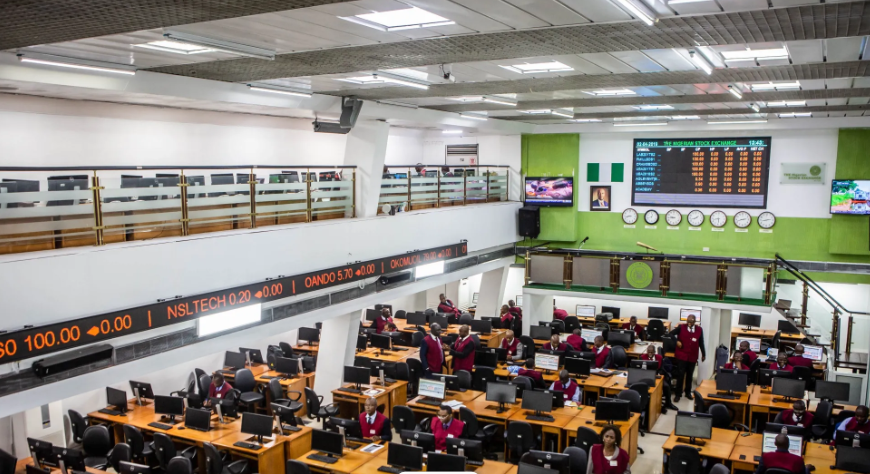
Nigeria’s equities market may experience renewed volatility in November as investors contend with profit-taking, high stock valuations and uncertainty surrounding monetary policy, according to Cowry Asset Management Limited.
The investment firm issued the warning in its October 2026 Monthly Economic and Financial Markets Bulletin, describing the outlook for the Nigerian Exchange (NGX) as cautiously constructive but increasingly selective.
The assessment comes after the Nigerian stock market recorded positive overall performance in October, extending its gains despite significant differences in the performance of individual sectors.
According to the report, the NGX All-Share Index appreciated by 1.23 per cent during October to close at 254,299.49 points.
The market’s year-to-date return consequently increased to 63.42 per cent, reflecting the substantial gains recorded by Nigerian equities during the year.
Market capitalisation also increased by N2.01 trillion to N165.11 trillion during the month.
Although the figures indicate continued growth in the overall market, Cowry noted that the performance was not shared equally across all major sectors.
The Industrial Goods Index emerged as the strongest performer among the five major sectoral indices, recording a gain of 16.85 per cent.
However, other sectors experienced declines during the same period.
The Banking Index fell by 10.42 per cent, while the Insurance Index declined by 5.52 per cent.
The Oil and Gas Index also recorded a 2.58 per cent decrease, while the Consumer Goods Index lost 1.09 per cent.
The contrasting performances suggest that the market’s overall growth was supported by a relatively narrow group of stocks rather than a broad improvement across all sectors.
Cowry attributed the market’s performance partly to selective institutional demand, corporate earnings and portfolio movements between different sectors.
The investment firm also identified Dangote Cement as an important contributor to October’s positive performance.
The company’s shares appreciated by 33.12 per cent to close at N1,420 during the month, helping to support the Industrial Goods Index.
However, the decline in banking stocks highlighted the selling pressure affecting some financial institutions after previous market advances.
Cowry warned that investors could become increasingly cautious as they assess whether current share prices adequately reflect the financial performance and future earnings potential of listed companies.
One of the major concerns is profit-taking.
Profit-taking occurs when investors sell shares after prices have increased in order to secure their investment gains.
This activity can create temporary downward pressure on share prices, particularly when a market has experienced a prolonged period of growth.
High valuations are another factor that could influence market performance.
When share prices rise significantly, investors may become more concerned about whether companies can generate enough profits to justify their market valuations.
Corporate earnings will therefore remain important in determining which stocks attract investor interest.
Cowry expects stronger-than-anticipated nine-month corporate earnings to provide support for fundamentally attractive companies.
The firm also believes that resilient market liquidity could help sustain investment activity.
However, it warned that uncertainty surrounding monetary policy, inflation and broader economic conditions could limit further market appreciation.
Developments in the fixed-income market may also influence investors’ decisions.
The report showed that domestic Federal Government bond yields increased to 16.18 per cent at the end of October, compared with 15.90 per cent in September.
Higher bond yields can make fixed-income investments more attractive compared with equities, depending on investors’ risk appetite and return expectations.
Consequently, some investors may decide to move funds from shares into government securities if they consider the available returns more attractive.
Cowry also highlighted developments in Nigeria’s inflation and foreign exchange markets.
Headline inflation moderated for the fourth consecutive month to 14.63 per cent in September 2026, compared with 15.39 per cent in August.
Although the decline represents an improvement, rising energy costs and pressure on household purchasing power remain important concerns for businesses.
The naira also depreciated by 1.31 per cent in October to close at N1,346.86 per dollar, ending a three-month appreciation streak.
Meanwhile, external reserves increased to approximately $55.26 billion by October 28.
These developments demonstrate the importance of macroeconomic stability to the performance of listed companies.
Exchange rate movements can affect businesses that depend on imported raw materials, while inflation can increase operating costs and reduce consumer spending.
For investors, the latest outlook suggests that careful stock selection may become increasingly important.
Rather than relying entirely on overall market growth, investors may need to pay closer attention to corporate earnings, financial strength, valuations and the sustainability of business operations.
Cowry’s assessment does not suggest that the Nigerian equities market will necessarily experience a major decline. Instead, it highlights the possibility of more uneven performance as investors become increasingly selective.
The direction of the market in November will depend on corporate earnings, liquidity conditions, interest rate expectations and broader economic developments.