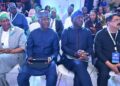
Lagos State Governor, Babajide Sanwo-Olu, on Thursday led the state’s commemoration of Nigeria’s 66th Independence Anniversary, joining Deputy Governor Obafemi Hamzat, senior government officials, security agencies, students and other residents at a ceremonial parade held at the Mobolaji Johnson Arena, Onikan.
The celebration featured a colourful parade involving the Nigeria Police Force, paramilitary agencies and students, with Sanwo-Olu taking the ceremonial salute and inspecting the parade after the rendition of the national anthem. The programme also included the cutting of the Independence Anniversary cake.
Government officials, traditional rulers, members of the diplomatic community and schoolchildren were among those who attended the ceremony as Lagos joined the rest of the country in marking 66 years since Nigeria gained independence from Britain on October 1, 1960.
Onikan Venue Evokes Nigeria’s Independence History
Beyond the ceremonial activities, Sanwo-Olu used the occasion to reflect on Lagos’ historical connection to Nigeria’s independence.
The governor recalled that the Union Jack was lowered and Nigeria’s green-white-green flag raised at midnight on October 1, 1960, only a short distance from the present-day Mobolaji Johnson Arena.
For Sanwo-Olu, the location therefore provided a symbolic setting for reflecting on Nigeria’s journey from colonial rule to an independent federation.
He stressed that independence belonged not only to political leaders but also to the ordinary Nigerians who witnessed and participated in the country’s transition to self-government.
Sanwo-Olu Highlights 27 Years of Continuous Democracy
The governor also highlighted Nigeria’s democratic journey, pointing to 27 uninterrupted years of constitutional government since the return to civilian rule in 1999.
Nigeria has experienced civil war, military governments, economic crises and periods of severe political instability since independence.
Despite those challenges, Sanwo-Olu said the country had remained together, describing its continued existence as one federation as evidence of the resilience of Nigerians.
The current democratic period is the longest uninterrupted stretch of civilian rule in Nigeria’s post-independence history.
The governor said the national flag had remained a symbol of that endurance throughout periods of war, hardship and political upheaval.
Governor Acknowledges Economic Hardship
Sanwo-Olu also acknowledged the economic difficulties confronting households, particularly the impact of rising food, transportation and other living costs.
He said recent economic reforms had required significant sacrifices from ordinary families and argued that attention must increasingly turn towards ensuring that the eventual gains translate into better living standards.
The comments reflected the economic dimension of this year’s Independence Anniversary, coming as households and businesses continue to adjust to changes in prices and wider economic reforms.
The Federal Government had declared October 1 a public holiday to commemorate the anniversary, calling on Nigerians to embrace unity, patriotism, peaceful coexistence and mutual respect.
Lagos’ Development Takes Centre Stage
Sanwo-Olu also used the anniversary to reflect on Lagos’ development and its wider importance to Nigeria.
He described Lagos as a microcosm of the federation, where people from virtually every region live, work, establish businesses and pursue economic opportunities.
The governor highlighted investments by his administration across transportation, healthcare, education, roads and digital governance.
Among projects referenced were the Blue and Red rail lines, alongside road and bridge projects, healthcare infrastructure and the expansion of tertiary education.
However, Sanwo-Olu said the achievements should not be credited to government alone, arguing that Lagos residents contributed through taxes, patience, civic engagement and demands for accountability.
Security Agencies, Students Join Ceremonial Parade
The Independence Day celebration also placed significant emphasis on the country’s security and uniformed services.
Personnel from the Nigeria Police Force, Nigeria Security and Civil Defence Corps, Nigerian Legion and other participating agencies took part in the ceremonial proceedings at the arena.
Schoolchildren also participated, representing a younger generation that will inherit responsibility for Nigeria’s development in the decades ahead.
Sanwo-Olu urged young Nigerians to protect the country’s unity and improve on what previous generations had built.
The governor said the task of nation-building remained unfinished and called on citizens to continue contributing to Nigeria’s development.
Lagos Marks Nigeria’s 66-Year Journey
Nigeria’s 66th Independence Anniversary comes more than six decades after the country formally emerged from British colonial administration.
Since 1960, the country has experienced profound political, demographic and economic changes while remaining Africa’s most populous nation.
Thursday’s ceremony in Lagos combined those historical reflections with the traditional symbolism of the Independence Day parade — the national anthem, ceremonial inspection, security formations and the green-white-green flag.
For Lagos, the significance was heightened by the historical role the city played when independence was formally celebrated in 1960.
Sixty-six years later, the gathering at Onikan offered another opportunity to reflect on the distance Nigeria has travelled and the challenges that remain.
Sanwo-Olu’s message placed responsibility for the country’s next phase particularly on younger Nigerians, urging them to regard the nation as an inheritance that must be protected, strengthened and ultimately passed to another generation.