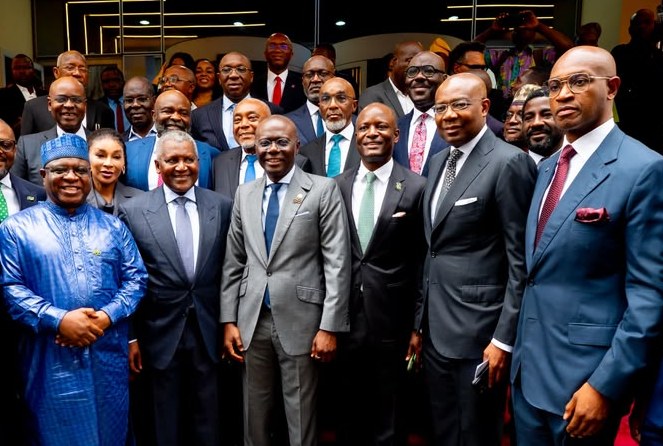
Lagos State Governor Babajide Sanwo-Olu joined billionaire industrialist Aliko Dangote and some of Nigeria’s most prominent business and capital-market leaders at the Nigerian Exchange, NGX, in Marina on Monday as Dangote Petroleum Refinery and Petrochemicals FZE formally opened its landmark Initial Public Offering, IPO, to investors.
The September 14 ceremony marked the beginning of a public offer expected to raise approximately ₦2.15 trillion, potentially making it Africa’s largest IPO and one of the most consequential listings in the history of Nigeria’s capital market.
Dangote formally marked the opening by sounding the gong on the NGX trading floor.
The offer comprises 4.1 billion new ordinary shares priced at ₦525 each, allowing investors to subscribe with a minimum of just 10 shares — equivalent to ₦5,250. The offer is scheduled to remain open until October 13, subject to the terms contained in the approved prospectus.
The transaction gives retail and institutional investors an opportunity to acquire a direct equity stake in the company behind the massive Lekki-based refinery.
Sanwo-Olu Joins Business Heavyweights at Marina
Sanwo-Olu’s presence at the ceremony was confirmed in photographs and reports from the event, placing the Lagos governor alongside some of Nigeria’s most influential figures in business, banking and the capital market.
Among those attending were Dangote; NGX Group Chairman Umaru Kwairanga; Zenith Bank founder Jim Ovia; Coronation Group Chairman Aigboje Aig-Imoukhuede; Zenith Bank Group Managing Director/CEO Adaora Umeoji; senior Dangote Group executives, including Fatima Aliko-Dangote and Mariya Dangote; and the Ooni of Ife, Oba Adeyeye Enitan Ogunwusi.
Their presence reflected the scale of a transaction expected to significantly alter the composition of Nigeria’s equity market.
It also carried particular significance for Lagos.
The refinery is located in the Lekki Free Zone axis of Lagos State, while the public offer itself was formally launched at the country’s principal equities exchange in Marina — bringing together two important sides of Lagos’ economy: large-scale industrial development and financial-market activity.
First Refinery Public Offer in NGX’s 66-Year History
The transaction is historic for another reason.
Dangote Petroleum Refinery becomes the first petroleum refinery to offer shares for public subscription on the Nigerian stock market in the Exchange’s 66-year history, according to reports from the launch.
The significance extends beyond the oil and gas industry.
Nigeria’s stock market has traditionally been dominated by banks, telecommunications companies, consumer-goods businesses and other established corporate groups.
Introducing a refinery of Dangote’s scale substantially increases the exposure of the Nigerian equity market to the country’s downstream petroleum and industrial sectors.
The IPO is also unusually large.
At ₦525 for each of the 4.1 billion shares being offered, the transaction is seeking approximately ₦2.15 trillion — about $1.6 billion at prevailing exchange rates. Reuters describes it as Africa’s largest IPO.
Dangote: IPO About Broadening Ownership
Dangote used the opening ceremony to position the offer as more than a capital-raising exercise.
He said the objective was to broaden ownership of the refinery and give ordinary Nigerians and other investors an opportunity to participate in the value being created by one of Africa’s biggest industrial projects.
According to Dangote, the transaction was intended to support the “democratising [of] wealth creation”, rather than simply raising money.
That argument explains the relatively accessible minimum subscription.
At ₦5,250 for 10 shares, the offer has been structured to accommodate smaller retail investors alongside wealthy individuals and institutional investors.
Dangote said the company was inviting investors from Nigeria, across Africa and internationally to participate in the business.
The company has also emphasised that shares carry investment risk, meaning their value can rise or fall and investors may not recover the full amount invested.
Refinery Valued at Nearly $48bn
The scale of the underlying business helps explain why the IPO is attracting considerable attention.
Reuters estimates the refinery’s valuation at approximately ₦63 trillion, or $47.59 billion, based on the transaction.
The refinery was constructed over roughly a decade at a reported cost of about $20 billion and currently has production capacity of around 700,000 barrels per day.
Dangote plans to expand that capacity to approximately 1.4 million barrels per day over the next three years, potentially placing the Lagos facility among the world’s largest refining complexes.
Proceeds from the IPO are expected to support that expansion and strengthen the company’s ability to access capital in the future.
The refinery has also moved from its costly construction and start-up phase into profitability. Reuters reported net profit of about $1.82 billion in the first half of 2026, on revenues exceeding $13 billion.
That turnaround is particularly important to prospective shareholders because an IPO is ultimately an investment in the company’s future earnings rather than simply its physical assets.
Potential Game-Changer for NGX
For the Nigerian Exchange, the listing could have an equally significant impact.
The addition of a company valued in the tens of trillions of naira could substantially expand NGX market capitalisation and deepen the market’s industrial representation.
It may also increase international attention on Nigerian equities.
Dangote indicated at the ceremony that NGX would serve as the company’s primary market before the group considers possible listings elsewhere, reinforcing Nigeria and Africa as the base of its capital-market strategy.
If the IPO attracts the expected participation, it could strengthen arguments that Nigeria’s capital market can finance industrial projects on a scale historically associated with international markets.
That would be significant at a time when Nigerian regulators and market operators are trying to attract more companies to the exchange and deepen domestic participation.
SEC Warns Investors Against IPO Scams
The sheer scale and public interest surrounding the offer have already prompted a warning from the Securities and Exchange Commission, SEC.
Following its approval of the IPO, the regulator advised prospective investors to use only officially designated receiving agents and approved subscription channels.
The SEC specifically warned Nigerians against transferring money to individuals or organisations claiming to guarantee allocations or preferential treatment. It also advised investors to disregard unsolicited calls, WhatsApp messages, emails and social-media advertisements offering unofficial access to the shares.
Investors have been advised to read the approved prospectus and understand the risks before subscribing.
That warning is important because the publicity surrounding a ₦2.15 trillion offer creates an obvious opportunity for fraudsters attempting to imitate legitimate investment platforms.
From Lekki Industrial Project to Public Company
For Lagos, Monday’s ceremony also represents another stage in the evolution of a project that has transformed the industrial landscape around Lekki.
The refinery began as a privately financed megaproject requiring years of construction, infrastructure development and investment.
It has since become operational, begun supplying petroleum products and is now opening ownership to the investing public.
Sanwo-Olu’s attendance at the NGX ceremony therefore connects the state government with both sides of that transition — from the physical industrial development taking place in Lagos to the capital-market transaction being launched in Marina.
But the significance of the IPO will ultimately depend on what happens after the ceremonial gong.
The offer must attract investors, the refinery must deliver sustainable earnings, its planned expansion must be executed successfully, and shareholders must ultimately see value from the capital they commit.
The offer closes on October 13, while Reuters reports that trading in the shares is expected to begin on the Nigerian Exchange in late November 2026.
If successful, the transaction could establish a new benchmark for African capital markets — demonstrating that one of the continent’s biggest privately developed industrial assets can move from billionaire ownership towards substantially broader public participation.
For Sanwo-Olu and Lagos, the moment carries an additional symbolism: Africa’s largest refinery is located in Lagos, while what could become Africa’s largest IPO began its public-market journey from the heart of Lagos Island.