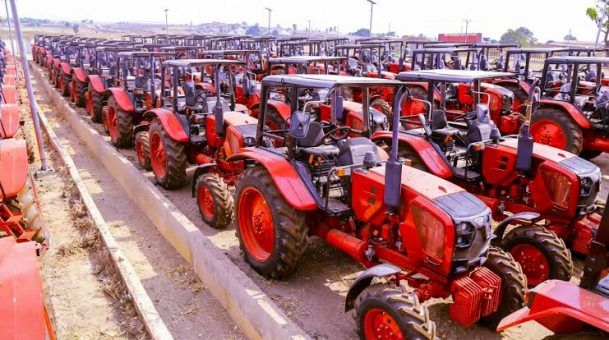
The Federal Government has announced plans to establish a mega tractor assembly plant with the capacity to produce between 2,000 and 4,000 tractors annually as part of efforts to strengthen agricultural mechanization in Nigeria.
Minister of Agriculture and Food Security, Abubakar Kyari, disclosed this in Abuja while unveiling the National Agricultural Mechanization Policy and the National Agricultural Mechanization Investment Strategy.
Kyari said the two policy instruments provide a framework to move Nigeria from agricultural potential to an agricultural powerhouse, from a mechanization deficit to mechanization leadership, and from food vulnerability to food sovereignty.
According to the minister, the proposed tractor assembly plant will reduce Nigeria’s dependence on imported machinery, promote local production, create jobs and support the development of a sustainable agricultural mechanization economy.
He said efficient and sustainable food production requires more than access to land and good intentions, stressing that mechanization must be viewed as an entire ecosystem rather than simply the provision of tractors.
Kyari explained that the ecosystem covers land preparation, planting, irrigation, crop protection, harvesting, processing, storage, logistics, precision agriculture, digital technologies, financing, insurance, maintenance and after-sales services.
He said Nigeria must develop a “mechanization as a service” economy, where farmers can access the appropriate technology when and where it is needed at commercially viable costs and through sustainable financing models.
The minister also disclosed that under the Renewed Hope National Agricultural Mechanization Programme (RH-NAMP), the Federal Government had commenced the procurement and deployment of 2,000 tractors alongside more than 9,000 assorted implements and spare parts.
He described the intervention as the largest single agricultural mechanization programme ever undertaken in Africa.
However, Kyari said the significance of the programme should not be measured solely by the number of machines deployed, but by whether the equipment becomes productive economic assets that are properly maintained, financed, utilised and made accessible to farmers.
He called on investors, young people and women to take ownership of opportunities emerging from Nigeria’s agricultural mechanization drive.
“Nigeria is open for investment in agricultural mechanization. We are not seeking capital merely to purchase machines. We are seeking partners to build an enduring agricultural technology and services ecosystem,” he said.
Kyari added that agriculture had moved beyond being viewed as a neglected sector and had become an area of enterprise, technology and wealth creation.
“Our youths must not stand at the edge of the mechanization economy. They must own, operate, innovate and lead it,” he said.
The minister also highlighted developments in Borno State, citing the state government’s delivery of 200 truckloads of fertiliser to farmers and the unlocking of more than a dozen solar-powered irrigation systems and sites to extend the farming season.
In his remarks, Borno State Governor, Babagana Zulum, commended President Bola Ahmed Tinubu’s Renewed Hope Agenda in the agricultural sector, saying it was geared towards achieving food sovereignty and economic growth.
Zulum said the Federal Ministry of Agriculture and Food Security’s mechanization programme would revolutionise Nigeria’s agricultural ecosystem and contribute to increased productivity across the sector.