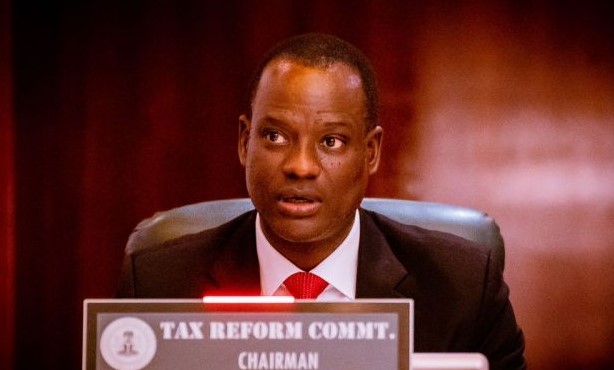
The Minister of Finance and Coordinating Minister of the Economy, Taiwo Oyedele, has said Nigeria’s revenue challenge is not about increasing tax rates but expanding the country’s tax net to bring more eligible taxpayers into the system.
Oyedele made the remarks in Abuja while receiving the leadership of the Chartered Institute of Taxation of Nigeria (CITN) during a courtesy visit to the Federal Ministry of Finance.
The visit marked the conclusion of the Institute’s maiden National Tax Awareness Day, which featured a road walk, taxpayer sensitisation at Wuse Market and a visit to the headquarters of the Nigerian Revenue Service (NRS).
The awareness campaign also coincided with the first anniversary of President Bola Tinubu’s signing of Nigeria’s landmark Tax Reform Acts into law on June 26, 2025.
Commending the Institute for supporting the Federal Government’s tax reform agenda, Oyedele said public misconceptions about taxation remain one of the biggest obstacles to improving tax compliance.
According to him, many Nigerians mistakenly believe that whenever the government discusses taxation, it is simply looking for ways to collect more money from citizens.
“We are still not getting enough revenue from taxes; it is not about increasing taxes, but making sure that those who are supposed to pay taxes pay. We want to promote fairness in tax administration,” he said.
The minister added that building an efficient and equitable tax system would have a transformative impact on Nigeria’s economic development.
He also encouraged the Institute to establish annual awards to recognise the country’s most compliant taxpayers as a way of promoting voluntary tax compliance.
Earlier, during the taxpayer sensitisation at Wuse Market, the 17th President of the Chartered Institute of Taxation of Nigeria, Innocent Ohagwa, said the awareness campaign was introduced to bridge the information gap surrounding the country’s tax reforms.
He explained that despite one year of implementation, many Nigerians still do not fully understand the provisions of the new tax laws and how they affect businesses and individuals.
“The laws have been signed, implementation has begun, yet many taxpayers and stakeholders are still grappling with what has changed, what remains the same, and how these provisions affect their businesses and personal affairs,” he said.
Ohagwa noted that misconceptions have created unnecessary anxiety, with some people believing the reforms introduced new taxes across all sectors of the economy, while others assume the objective is solely to increase government revenue.
He stressed that the reforms also contain several reliefs and incentives for individuals and businesses.
According to him, individuals can now claim rent relief of up to 20 per cent of annual rent paid, subject to a maximum of N500,000.
He added that essential goods and services, including food, education, healthcare, electricity transmission and non-oil exports, now enjoy zero-rated Value Added Tax (VAT).
Ohagwa further stated that compensation for loss of employment or personal injury now benefits from higher tax exemption thresholds.
For businesses, he said companies with annual turnover of not more than N100 million and fixed assets valued at no more than N250 million are exempt from Companies Income Tax (CIT), Capital Gains Tax (CGT) and the Development Levy.
“This means thousands of small businesses can now reinvest in growth, job creation, and innovation,” he said.
He added that targeted tax incentives have also been introduced for agriculture, aquaculture, dairy production, cocoa processing and animal feed manufacturing, while qualified investors can benefit from tax credits under the Economic Development Incentive.
Despite the available incentives, the CITN president reminded taxpayers that compliance remains a legal obligation.
“Compliance is not a burden; it is a civic duty. It is our collective contribution to nation-building. And taxation works best when there is trust — taxpayers must fulfil their obligations, while the government must uphold accountability, transparency and the effective use of public resources,” he said.
Ohagwa urged traders, entrepreneurs and business owners to obtain Tax Identification Numbers (TINs), maintain proper financial records, file accurate tax returns on time and seek professional guidance whenever necessary.
He explained that Wuse Market was selected for the maiden campaign because of its strategic importance as one of Nigeria’s major commercial centres where taxpayer education is most needed.
Following the market sensitisation, the CITN delegation visited the headquarters of the Nigerian Revenue Service, where both organisations reaffirmed their commitment to strengthening taxpayer education and voluntary compliance.
Receiving the delegation on behalf of the Executive Chairman of the NRS, Dr. Zacch Adedeji, the Executive Director, Finance and Corporate Services, Mohammed Abubakar, described the occasion as a significant milestone in Nigeria’s tax reform journey.
“That historic milestone signalled the beginning of a new era in Nigeria’s tax administration, one anchored on simplicity, fairness, transparency, efficiency, and service delivery,” he said.
According to Abubakar, the reforms are designed to build a trusted, technology-driven tax administration system that responds effectively to the needs of taxpayers and businesses.
He noted that sustainable revenue generation depends not only on enforcement but also on public confidence and awareness.
“Taxpayers are more likely to comply when they understand their obligations, appreciate the value of taxation and have confidence in the institutions administering our tax laws,” he said.
The visit also showcased the Nigerian Revenue Service’s digital transformation initiatives, including the Rev360 platform and other technology-driven solutions aimed at improving tax administration.
Also speaking, the Group Director of the Medium Tax Group at the NRS, Dr. Gbenga Daniel, reaffirmed the agency’s commitment to collaborating with professional bodies to improve taxpayer education and service delivery.
“The Nigerian Revenue Service values its longstanding partnership with CITN. Together, our institutions share a common vision of improving tax administration and fostering voluntary compliance for national development,” he said.
The event brought together members of the CITN Governing Council, Executive Directors of the NRS, senior management staff, tax professionals and other industry stakeholders.
Nigeria’s current tax reform programme began in June 2025 when President Bola Tinubu signed four major tax reform bills into law, including the Nigeria Tax Act, aimed at modernising the country’s tax administration system.